Tudor London Secrets: 5 Hidden Spots Henry VIII Would Still Recognise Today

When we think of Tudor London, our minds usually drift toward the sprawling grandeur of Hampton Court Palace or the chilling, stone-cold towers of the Tower of London where two of Henry VIII’s wives were executed. Those spots are magnificent, of course, but they are the “obvious” boxes to tick. If you really want to feel the presence of the man who redefined England through sheer force of will, appetite, and paranoia, you have to look a little closer.

The Great Fire of 1666 did a fairly thorough job of erasing the Tudor timber and wattle-and-daub from the City skyline. However, if you know where to turn or which unassuming basement to peer into, you can still find the London that Henry, Anne Boleyn, and Elizabeth I called home.

In this post, we’re going to step off the main tourist trail and unearth five hidden gems where the Tudor spirit still lingers in the bricks, the beams, and the bloody history. These are the places that possess a particular kind of magic: where, if you squint just right, you might catch the ghost of a velvet-clad monarch making his way to a secret rendezvous.

1. The Gatehouse of St James’s Palace

changing the guard tour - St James Palace

While everyone is busy crowding around the gates of Buckingham Palace to see the Changing the Guard (which we absolutely recommend doing with us on our Small Group Changing the Guard Tour), the real Tudor treasure is just a five-minute stroll away.

Built on the site of a former leper hospital, St James Palace was meant to be a more intimate residence compared to the sprawling Whitehall Palace, and an ideal ‘lodge’ from which to be based while enjoying hunts in the surrounding area.

The most striking remnant of his era is the massive red-brick gatehouse that towers over the bottom of St James’s Street. Red brick was a new construction material in the 16th century, and this building would have been a great example of contemporary modern architecture.

Inside the Chapel Royal, the ceiling is adorned with the coat of arms of Henry VIII’s fourth wife, Anne of Cleves, in what is considered to be one of the most beautifully decorative Tudor ceilings in England.


2. Henry VIII’s Wine Cellar (The Whitehall Survivor)

This is perhaps London’s best-kept secret for those who love a bit of “hidden” history. We often talk about Whitehall Palace, which was the primary residence of the English monarchs until it burned down in 1698. Today, the Banqueting House is the only bit left standing above ground… or so most people think.

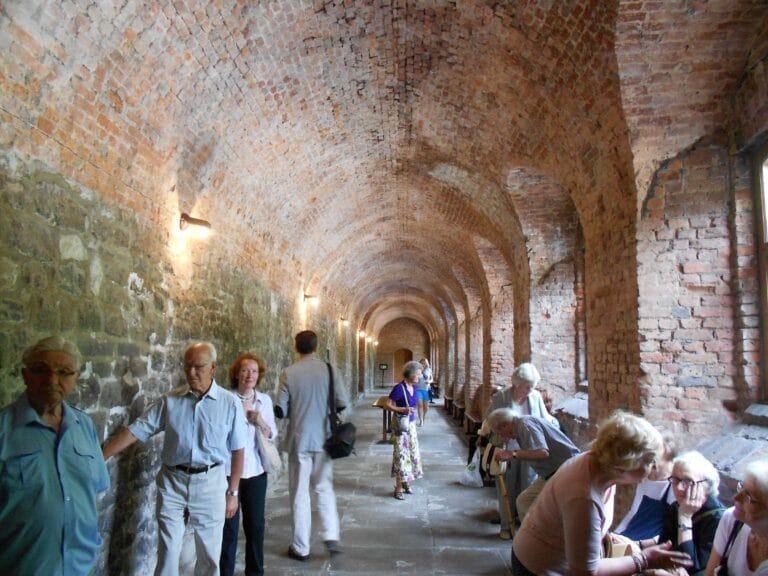
Deep beneath the modern, imposing Ministry of Defence building on Horse Guards Avenue lies a literal piece of Henry’s daily life: his wine cellar. Built around 1530, this vaulted brick chamber is a survivor of the original palace. When the Ministry of Defence was being built in the 1930s, they didn’t bulldoze this historical relic; they moved the entire cellar – all 800 tonnes of it – several feet to accommodate the new foundations.

Henry was a man of legendary consumption, and this cellar would have once held the vast quantities of wine required to keep his court lubricated and happy. It’s a space of shadows, silence, and stone: a genuine Tudor interior that hasn’t changed its character in 500 years. Access is usually limited to special heritage days, but just knowing it’s there, beneath the feet of modern civil servants, adds a layer of mystery to every walk through Westminster.

3. The Charterhouse, Smithfield

secret old london tour -Charterhouse

If you want to understand the sheer drama and destruction of the Tudor era, the Charterhouse is the place to do it. Tucked away near Smithfield Market, this site began life as a Carthusian monastery. During the Dissolution of the Monasteries, Henry VIII’s reformers didn’t exactly play nice here: the monks refused to acknowledge Henry as the Head of the Church, and let’s just say it didn’t end well for them.

However, the site was eventually transformed into a grand Tudor mansion. When you walk through the courtyards of the Charterhouse today, you are surrounded by the same walls that Elizabeth I stayed in for several days before her coronation in 1558. It’s a place of immense peace, beauty, and history, surviving both the Reformation and the Blitz.

We explore this incredible site on our Secret Old London Tour where we dive into the “weird and wonderful” side of the city that most tourists walk straight past. The Charterhouse is a masterclass in how London layers its history: monastery, mansion, school, and almshouse.


4. The Gatehouse of St Bartholomew-the-Great

Secret Old London tour - St Bartholomew the Great gatehouse

Staying in the Smithfield area, there is a tiny, timber-framed gatehouse that looks like it has been plucked straight out of a storybook. It sits atop a 13th-century stone archway leading to the church of St Bartholomew-the-Great.

This gatehouse was built at the end of the 16th century, during the reign of Henry’s daughter, Elizabeth I. It survived the Great Fire of London because it was just outside the reach of the flames, and it survived the Victorian urge to modernise because it was hidden behind a facade of tiles for centuries. It wasn’t until a bomb blast in 1917 loosened the tiles that the original Tudor timbers were revealed to the world again.

When you stand in front of this gatehouse, you are looking at the quintessential Tudor London. The overhanging upper floors, the dark wooden beams, and the sense of precarious age are exactly what the streets of the 16th century would have looked like. It’s a portal back in time that requires no imagination: just a pair of eyes and a sense of wonder.


5. King Henry’s Mound, Richmond Park

For our final spot, we have to travel a little further west to the sprawling green expanse of Richmond Park. While the park is famous for its deer and its views, there is one specific spot that holds a legendary connection to Henry VIII’s most infamous deed.

King Henry’s Mound is the highest point in the park. According to local lore, Henry stood on this very spot on May 19, 1536. He was supposedly waiting for a signal rocket to be fired from the Tower of London, confirming that his second wife, Anne Boleyn, had been executed. This would clear the way for him to marry Jane Seymour the very next day.

While historians like to debate the logistics of seeing a rocket from that distance (and consider the story to be apocryphal given that Henry was most likely in Wiltshire!) the mound itself is a prehistoric burial chamber that Henry would have known well. What makes it truly special today is the “protected view.” From the telescope on the mound, you can look through a gap in the trees and see St Paul’s Cathedral miles away in the City. It’s a direct physical link between the royal hunting grounds and the heart of the capital: a view that has remained remarkably consistent for centuries.


Discover the Shadows of the Past

London is a city that hides its best stories in plain sight. Whether it’s the initials of a doomed queen carved in stone or a wine cellar buried beneath a modern office, the Tudor era is never as far away as it seems. These spots offer a sense of intimacy and connection that the larger palaces sometimes lose in the crowds.

When you join us for a walking tour, we don’t just show you the big monuments; we take pride in pointing out these “wrinkles in time.” Our guides: like Matt or Rachel: love nothing more than sharing the grit, the glamour, and the gossip of the people who walked these streets 500 years ago.

If you’re ready to see the side of London that Henry VIII would still recognise, why not check out our Secret Old London tour?  We’d love to help you unearth the mystery and magnificence of our favourite city.

The Tudors may be long gone, but their London is still waiting for you. You just need to know where to look…

If you’d like to unearth the colour, mystery and
magnificence of this great city, join one of our Walking Tours!
London Icons