Imagine, if you will, the sound of a distant air-raid siren wailing across the Thames. It is late 1940, and the London Blitz is at its height. Above ground, the city is a landscape of fire, grit, and resilience. But beneath the surface: hidden away from the falling debris and the prying eyes of enemy scouts: a different kind of war is being waged. This is the story of London’s secret underground, a world of bunkers, tunnels, and tactical nerve centres where the fate of the free world was decided over maps and tobacco smoke.
When we think of WW2 London, we often picture the stoicism of the East End or the iconic images of St. Paul’s Cathedral standing tall amidst the smoke. However, to truly understand how Britain survived its darkest hour, you have to dig a little deeper. You have to go beneath the pavements of Westminster and unearth the secrets of Winston Churchill and his subterranean command.
The Nerve Centre: The Cabinet War Rooms
Nestled beneath the unassuming Treasury building in Whitehall lies the most famous of all London’s bunkers: the Cabinet War Rooms. Work began to convert the basement in June in 1938, as the clouds of war were gathering over Europe. By August 1939, just one week before the declaration of war, the facility was fully operational.
It wasn’t exactly a luxury suite. In fact, Churchill himself was notoriously reluctant to head underground. He preferred the fresh air and the view from the rooftops, even as the bombs began to fall. It took a direct hit on his cook’s kitchen at 10 Downing Street to finally convince him that perhaps a bit of reinforced concrete wasn’t such a bad idea after all.
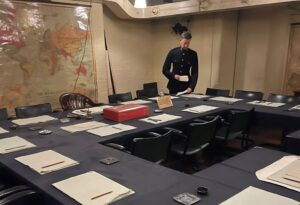
Once inside, you realize this wasn’t just a shelter; it was a hive of strategy, tension, and endurance. The rooms were protected by “The Slab”: a massive layer of concrete up to five feet thick. Within these walls, the War Cabinet met 115 times, navigating the complexities of the London Blitz and the eventual liberation of Europe.
The Map Room: Where History Was Written in Pins
If the Cabinet Room was the brain of the operation, the Map Room was its heart. This room was staffed 24 hours a day by officers from the Royal Navy, the Army, and the Royal Air Force. It was a hive of activity as the combined forces plotted their manoeuvres.
Even today, the room remains exactly as it was left on the day the lights were finally turned off in August 1945. You can see the original maps covering the walls, covered in thousands of tiny pinholes. Each pin represented a convoy, a troop movement, or a front line. For those of us who love London history tours, standing in this room feels like stepping directly into a time capsule.
When you join us for a walking tour, we often talk about the sheer pressure these officers were under. They weren’t just moving pins; they were managing the lives of millions.
The Secret Telephone: The “Green Hornet”
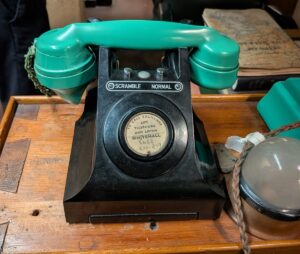
One of the most intriguing secrets of Churchill’s underground was a tiny room disguised as a private WC. If you were an interloper during the war, you’d have seen a “Vacant/Engaged” sign and moved on. But inside wasn’t a toilet: it was the most advanced communication technology of the era.
This was the home of the SIGSALY terminal, often nicknamed the “Green Hornet.” It was a custom-encrypted telephone provided by Bell Labs that allowed Churchill to speak directly to US Presidents Franklin D. Roosevelt and Harry S. Truman. Their voices were scrambled into white noise, making it impossible for German spies to eavesdrop on their transatlantic strategy sessions. It was the original “hotline,” and it changed the course of the war.
Down Street: The Forgotten Station
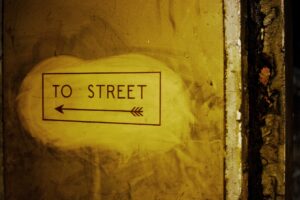
While the Churchill War Rooms are the most famous, they weren’t the only secret bunkers in town. Just a short walk away in Mayfair lies Down Street tube station. Closed to the public in 1932 due to low passenger numbers, it found a second life during the war as the bomb-proof headquarters for the Railway Executive Committee.
Churchill actually stayed here while the Cabinet War Rooms were being reinforced. He affectionately referred to it as “The Barn.” It offered a level of protection that even Downing Street couldn’t provide. Today, the deep-level platforms still hold the remains of the offices, bedrooms, and even a dining room where the high command would enjoy cigars and brandy while the world above was in chaos.
Navigating these hidden histories is what we do best. If you’re looking for an intimate Churchill’s London & War Rooms tour, exploring these lesser-known anecdotes is a highlight of the experience.
Paddock: The Backup Bunker
If the worst had happened and Whitehall had been destroyed, the government had a “Plan B.” Codenamed “Paddock,” this secret bunker was located in Neasden, North West London. Built deep under the Post Office Research Station, it was designed to house the entire War Cabinet and 200 staff members.
Churchill only used it for one formal meeting, famously stating that the location was “too far away” and “not very comfortable.” It remains a stark reminder of just how close London came to total evacuation. It is a place of shadows, silence, and cold concrete: a hidden piece of the puzzle for anyone interested in London history tours.
Walking the Path of a Giant
To truly appreciate the scale of Churchill’s leadership, you have to see the environment he operated in. It wasn’t just about the bunkers; it was about the streets of Westminster that he walked every day, the Parliament that he defended with his rhetoric, and the people he inspired during the darkest days of the London Blitz.
On our Small Group Iconic Westminster, WWII & Churchill War Rooms Tour, we weave these stories together. We don’t just show you a bunker; we tell you the story of a man and a city that refused to break. From the statue of Churchill in Parliament Square to the hidden entrance of the War Rooms, every corner has a secret to share.
[PHOTO DESCRIPTION: A poignant photo of the statue of Winston Churchill in Parliament Square, with the Big Ben and the Houses of Parliament in the background.]

Why Size Matters on a Tour
We believe that history is best served in small batches. Exploring the cramped quarters of a WW2 bunker or the narrow alleyways of Westminster is a far more personal experience when you aren’t part of a massive crowd. Our private Churchill tours ensure that you can hear every whisper of history, ask every burning question, and truly feel the atmosphere of the 1940s.
Whether you are a die-hard history buff or just someone looking to see a different side of the capital, the underground world of Winston Churchill offers a unique perspective on resilience and grit. It’s a chance to see how London stood up to the Nazis, not just with spitfires and radar, but with pens, maps, and an unbreakable spirit.
If you’re ready to delve into the past, we’d love to have you along. You can check our full tour schedule to find the perfect time for your adventure.
London’s secrets are waiting just beneath the surface… will you join us to unearth them?
Ready to Explore?
- For the full experience: Join our Small Group Iconic Westminster, WWII & Churchill War Rooms Tour.
- For a deeper dive into the man himself: Book our Private Intimate Churchill’s London & War Rooms Tour, run for your group alone
- Not sure yet? Browse all our tours to find your perfect London story.
London history is more than just dates and facts; it’s about the people who lived it. Let’s go find them.