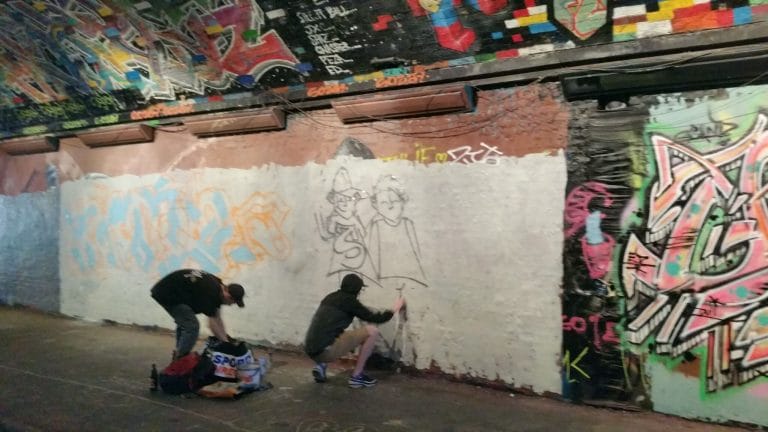
Today many of you may know Whitecross Street for its vibrant international food market which is super popular with the local workers during the week and also for its annual street art festival which takes place every July.
That event is one of the few opportunities where street artists can paint on the walls without fear of recrimination, and along the street you’ll find the likes of Conor Harrington, Urban Solid, Paul ‘Don’ Smith and DS Solid have left their mark.

Further works now adorn the side of the Peabody Housing Estate, and they certainly bring a splash of colour and imagination to the area, and walking along Whitecross Street feels like you are passing through an outdoor art gallery.
Check out these works by Otto Schade, Boxhead, Inkie, Zadok, Airborne Mark, Nathan Bowen

Moving back in time, it may not surprise you to know that this street was named after a stone white cross which once stood here as early as the 15th century. White stone crosses often represented the jurisdiction of the Knights Hospitallers – a wealthy religious order at the time – with the four arms representing the four virtues of prudence, temperance, fortitude and justice.
At one point the Hospitallers controlled Malta, and the Maltese Cross owes its history to the religious order, hence the similarity. Incidentally, if you are keen to delve into the order’s fascinating history, you can visit the Museum of the Order of St John in nearby Clerkenwell (below image).

Peeling back the veneer of modern hipster morality, this street’s history paints a picture of a place which has struggled to live up to those four Christian virtues!
A 17th century ballad went like this: ‘In Whitecross Street and Golden Lane do strapping lasses dwell, and so do there in every street, twixt that and Clerkenwell’
One such strapping lass was the notorious Priss Fotheringham who in around 1660, after a career of working in brothels, set herself up as the madam of the The Six Windmills tavern on the corner of Whitecross Street and Old Street.

During her younger years, she was described as ‘the second best whore in the city’, and gained great fame from her skill at the ancient art of ‘chucking’, where she would stand on her head, naked, and customers would throw coins into what at the time was known as her ‘commodity’. Not surprisingly this form of entertainment proved spectacularly popular, and the tavern became known as the ‘half crown chuck office’.

The 17th century also saw the street develop as one of London’s foremost Sunday markets. Being just outside the walls of the City of London, it thrived despite many God-fearing folk considering having a market on the Sabbath to be ‘vulgar’. It attracted working class people known as costermongers’ which translated into modern language means apple seller.
Over time, almost certainly to protect themselves from the law, they developed a secret language whereby they spoke words backwards – ‘boy’ became ‘yob’, table – ‘elbat’, and ‘penny’ – ‘yennap’. Alongside this they also developed a language we still know of today, called rhyming slang, which included phrases like ‘rubbedy dub’ for pub, and ‘trouble and strife’ for wife!
By the 19th century, following an article written by one of the first investigative undercover journalist James Greenwood which shocked the readership, Whitecross market became associated with poverty and alcohol, and was known as the ‘squalors market’.

So perhaps it could be argued that with so much law breaking and raucousness, Whitecross Street could be seen as an ideal place for a jail… In 1813 a debtor’s prison was built here to house up to 500 inmates and ease crowding in Newgate Prison in the City of London. But given that at this time you could be imprisoned for stealing a shilling or a sixpence, it is estimated that over 2000 people passed through these doors each year, and once incarcerated it was notoriously difficult to get out.


Fortunately once a year according to the 17th century Will of Nell Gwynne, prostitute turned favoured mistress of King Charles II, a sum of £20 was given to inmates of the prison to release them from jail on Christmas Day. By 1869 it was no longer possible to imprison people for debt, and the following year the jail closed down.
Today Whitecross Street really feels like a sanitised shadow of its former wild days, with even the anti establishment ethos of street art now here being challenged by being officially sanctioned and controlled by Islington Council. So maybe the four virtues of the ancient white cross are finally being fulfilled!

With thanks to Clerkenwell & Islington Guiding Association and the English Hedonists for providing the inspiration to write this article.
The Business Design Centre is regarded as one of the best conference and exhibition centres in the UK. Many of you may have been inside and seen the huge open spaces, an auditorium and scores of smaller rooms used as office space which is ideal for hosting hundreds of events each year.
Taking a break from closing other things down, it was opened by our former PM Margaret Thatcher in 1987 after a major restoration project by the businessman Sam Morris, who has a bust inside. He was keen to recreate the glory days of the building after it had laid empty and unloved for nearly 20 years.

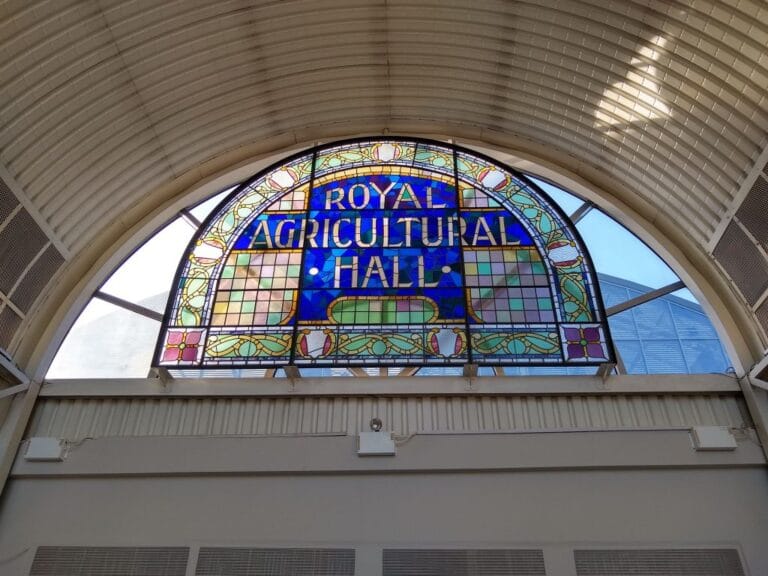
Opened in 1862, it was said to be inspired by construction of Crystal Palace in Hyde Park for the Great Exhibition in 1851. It was originally used for holding the annual Smithfield Show, and was known as the Royal Agricultural Hall. The first agricultural event here attracted 135k people, and every year usually over 100k arrived to observe agricultural innovations, equipment and animal husbandry.
It was also the host of the Royal Tournament from 1880 for 20 years, which was the greatest military event of the year.
Although the agricultural show was a huge success, there were inevitably fallow periods, and these were filled with some more unusual events.

In 1877 the first six day walking race took place here and drew crowds of 20,000, while the following year it held the first six day cycling event when a professional cyclist David Stanton wagered £150 (£12k in today’s money) that he could ride 1000 miles in six days, cycling for 18 hours each day. Amazingly he managed it within 73 hours!
Talking of global events, what is now the world’s most famous dog show, Crufts, had its first official competition here in 1891. It was organised by Charles Cruft, a local dog biscuit salesman, and immediately attracted aristocrats and royalty from across Europe. 2000 dogs were entered, including six by Queen Victoria, who not surprisingly won joint first prize! Some say it was ‘rough’ justice…

Unfortunately when the agricultural show moved out to West London in 1938 the building lost some sense of purpose, and despite being used temporarily as a parcel depot during the war by 1970 it was empty and unused except for occasional events and a bingo hall.
Its rebirth has been pretty spectacular, even being used as the home of Stella McCartney’s first graduate fashion show in 1996 and the BAFTAs in 1999 where rather appropriately given its agricultural past, Live Flesh was nominated for best foreign language film and Thora Hird won best television actress award!


1. identifying the regiment
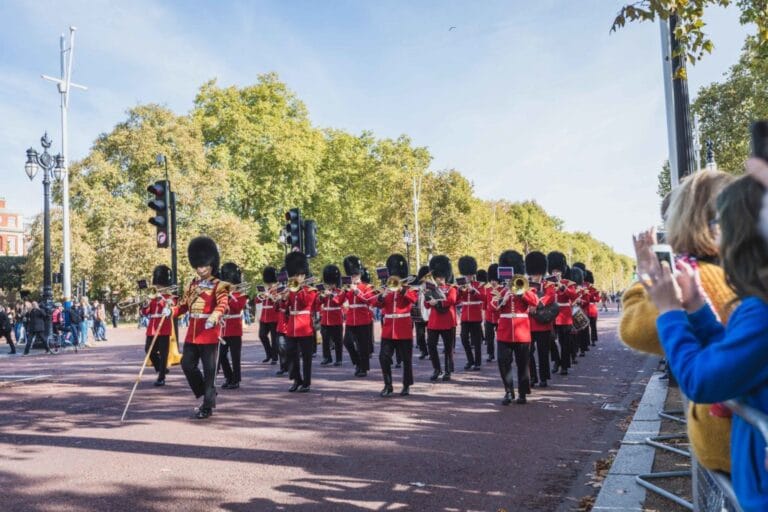
There are five regiments who you will usually see on display during the ceremony. The easiest way to identify the regiment is by the colour of the soldier’s plume, although you can also identify them by observing the arrangement of buttons on their tunics and symbol on their collar. Our personal favourite is the Welsh Guard who have a symbol of a leak on their collar, and their plume is white and green to represent the national vegetable of Wales!

2. Official Mascots of the British Army
If you are lucky you may see an official mascot during the ceremony. The Irish Guard have a wolf hound named Seamus, while occasionally when guest regiments have the honour of featuring in the ceremony, other mascots can be seen. The Royal Regiment of Scotland have a Shetland pony called Cruachan (as seen above), and our favourite has to be the Mercian Regiment’s Ram who is a Private in the army!
3. Changing the Guard Music
The music played by the regimental band at Buckingham Palace is chosen by the Captain of the Guard from a list presented to him by the Director of Music. Often the piece chosen will reflect the regiment, so for instance the Band of the Welsh Guard have been known to play music by Welsh musicians like Tom Jones and Shirley Bassey! Often the choice reflects a moment in history – Respect was played on the day of Aretha Franklin’s funeral, while May 4th tends to feature a Star Wars medley…

Image above – Gherkas from Nepal on duty in 2019
4. The uniforms.
You might be wondering why soldiers wear red tunics? Contrary to some rumours its not so that blood doesn’t appear to the enemy when shot! In 1645 when the New Model Army was formed a cheap form of dye was used to ensure all uniforms were of a similar colour. Naturally over time the uniforms faded and weren’t as bright on the battlefield. Warfare was of a different order then, with more orchestrated battles where the enemy could easily be identified. Red was interestingly useful as units naturally blend together wearing this colour, making it difficult to estimate numbers.

5. Who is in charge?
The Royal Family sits at the top of the British Army. As of March 2022, Queen Elizabeth II is the Head of the Armed Forces, while her son Prince Charles is not only Colonel of the Welsh Guard, but also Field Marshal, Admiral of the Fleet and Marshal of the Royal Air Force! Until there are changes at the top of the family, Prince William must settle for being Colonel of the Irish Guard. Each year the Queen inspects her troops on her official birthday in June – in an occasion called ‘Trooping the Colour’.

Learn more about this ceremony and enjoy the event in the company of award winning guides by booking onto our acclaimed changing the guard tour!
Post Date: 16th February 2015Author: Matt Gedge
Now that I’ve managed to find my way to the front of the queue in all the major attractions much easier thanks to the success of my first ‘Famous London Attractions and their Cheaper Alternative‘ post, I’ve decided to do another!
Westminster abbey vs St Brides Church

Extraordinary history, staggering importance, wonderful architecture and modern romance, Westminster Abbey has it all. This is the site on which William the Conqueror was crowned on Christmas Day 1066, with the resulting jubilations inside sending his soldiers into panic on the outside, presuming unrest and setting fire to the surrounding buildings. It is where George IV’s coronation was memorable in that he banned his own wife, and where of course Kate and William were married in 2011.
You’ll have to face mega queues in the summer thought, and it’ll be exceptionally crowded inside, and of course pretty expensive for a church at £18 for adults.
However, if its romance and remembrance you’re after, you’ll struggle to beat St Bride’s Church. The spire is the inspiration for the wedding cake, inside there is an incredibly touching ongoing vigil inside to journalists lost or missing, while downstairs you will discover an incredible array of items – including an iron coffin used to deter body snatchers, part of a roman pavement and a medieval charnal house.
St Bride was said to be able to turn water into wine but if she’s not feeling so charitable today don’t worry as you’re on Fleet street where you’ll find some of the most atmospheric pubs in London!
London Aquarium v Wetland Centre
Sharks, piranhas, stingrays and jellyfish. (Un)fortunately you won’t find them splashing around in the Thames (although a whale did get lost in our famous river not so long ago).

But you will see them all if you head to the Aquarium on the Southbank. However, if the fear induced by your proximity to so many natural predators is mollified by the safety of all that thick glass, then at least one thing will get your heart thumping fast: the entrance fee. At £26.50 for an adult ticket you may decide to look around for alternatives rather than being stuck in a fishy amusement arcade locked inside an old government building.
So how about the Wetland Centre? This beautiful and serene oasis within the frantic pollutant that is London can provide a welcome break from all the hustle and bustle.
The focus here is on conservation, preservation and living in harmony with nature but there is a lot of fun for the kids too – most notably on the bat walks! Like the crew from a Star Trek episode beamed down to an alien world you’ll be given a bat detector which picks up the sounds unheard by the human ear and then walk around in the dusk waiting to see them fly by.
And you’ll get the entire family in here for only a few quid more than the adult ticket at the Aquarium.
London Eye v Secret London Walking Tour
The London Eye affords first time visitors to London a great opportunity to get a bird’s eye view of this wonderful city. As you move around at a sedentary pace you’ll be transfixed by the majesty of Parliament, the dominance of the River Thames and possibly by the screaming of a baby next to you.
But don’t worry, you’ll be released from your capsule a mere half an hour later, much like you were relieved of £119.80 for your family ticket a short while before…
Those of you who prefer to explore the delights of this city rather than merely observe through a window may wish to join the Secret London tour.
You’ll be entertained, informed, and regaled with stories about a side to London which is lost on the average tourist. This is the London you can touch, and feel, where you can peer through the cracks, betraying a rather unusual and curious living history. And you may even be able to touch the Duke of Wellington’s nose! All for £12 per person.
West End Theatre v Shakespeare’s Globe
I must admit I’m not a big fan of musicals, so this one is pretty easy. Rather than spend an uncomfortably large sum on tickets to something I would only consider if it were free, I would strongly suggest going to the Globe Theatre instead.

Standing under the summer skies watching actors fulfil a dream to perform Shakespeare in such a historical and beautiful setting is rather overwhelming. As is the contemplation of the love and thought put into creating not only the production but also the building itself, which replicated the building materials of 400 years earlier.
The atmosphere is electric, the sense of being in something together is quite moving, and when you pour out of the theatre a few hours later you’ll be looking out on the Thames rather than a bustling central London street. And at £5 per person, it has to be one of the most reasonable tickets in the whole of the city.
Chelsea FC v AFC Wimbledon

‘Blue is the colour, football is the game. We’re all together and Chelsea is our name. We’ll lead you through the sun and rain, cos Chelsea, Chelsea is our name!’. So sing the fans of Chelsea FC, one of the most successful football clubs of recent years, a glowing example of how London’s soul is being torn out by obscenely rich Russian oligarchs.
As you join in with the other 40,000 or so casual fans from around the world, watching mollycoddled superstars prance around under the doting eye of their sugar daddy Roman Abramovitch, you can reflect that once upon a time, this was a community club. Tickets to see ‘Chelski’ are astronomical, so why not watch REAL english football?
There are currently 12 other football league clubs in London, so you’re really spoilt for choice.
Brentford’s Griffin Park has the wonderful distinction of being the only football league club to have a pub at every corner of the stadium, but if you want romance and history, I’d suggest watching AFC Wimbledon. This is the club who came from non-league football all the way to the top and won the FA Cup against mighty Liverpool in 1988. They’re also the only club in modern times to be stolen from their fanbase and taken to Milton Keynes. (We don’t do franchising of sports teams in England).
So rather than relocate, the vast majority of fans took it upon themselves to start the club again and begin the journey once more. This is real fan investment, and you can really feel it when you watch a game.
Ps The photo is of Arsenal FC as I couldn’t face going to Stamford Bridge…
Post Date:20th January 2015
Author:Matt Gedge
Ever thought you would like to avoid the queues and dig a little deeper into what is on offer in London? Is it your second visit here and you have already seen all the main attractions on the check list? Or do you simply want to find places which are reasonably cheap and slightly off the main tourist radar? Then this is the list for you!
London dungeon v Highgate Cemetery

The London Dungeon has been one of the most popular tourist attractions in London for a while now, and you can see why. It draws on the mystique of London and its seedier side more effectively than anywhere else and has an instant allure for kids. Nevertheless I didn’t find it frightening in the slightest, and only mildly entertaining, bah humbug. But if your children are pulling on your sleeves insisting you go, then maybe the £94 for a family of four is worth it?
But if that proves out of reach of your holiday budget, and you want to go somewhere genuinely creepy, historical, and full of real dead people rather than underachieving actors then why not head to Highgate cemetery? Although one half of the cemetery – the east – is free, to get the full experience either book yourself onto one of the daily guided tours during the week, or go along at the weekend and join one of the half hourly walks. You can’t help but be amazed at the extraordinary Victorian morbid grandeur while walking through the Terrace Catacombs and Egyptian Avenue. Its like being transported into a Hammer Horror movie without the fake blood and dodgy acting. And a family of four get in for £36.
Houses of Parliament (aka Palace of Westminster) v Guildhall
Ok, definitely go in both if you have a chance. I find the history, architectural beauty and sheer importance of Charles Barry and Augustus Pugin’s Victorian gothic masterpiece a real delight. Walking through the Central Lobby, iconic Lords and Commons Chambers or gaping at the over 900 year old Westminster Hall where the likes of William Wallace, King Charles I and Thomas More have been held on trial is a truly mindboggling experience. Arguably the best thing you could do on a trip to London. But it is £25, so…

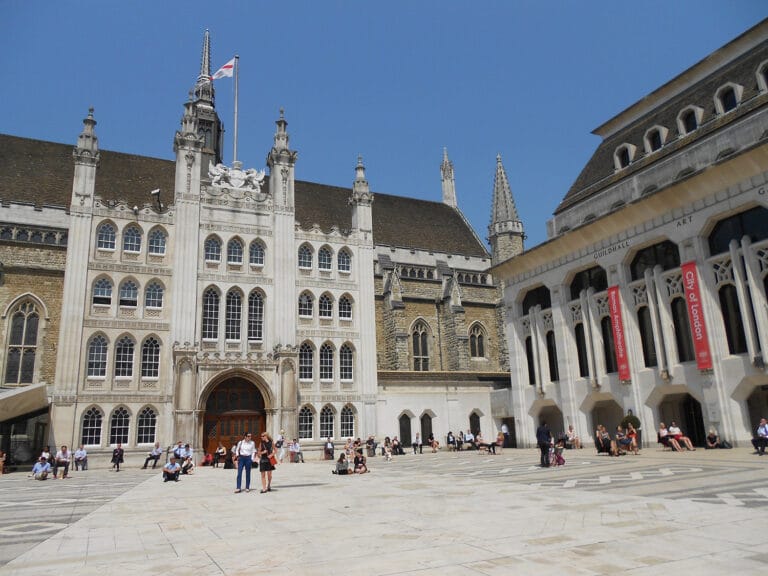
Why not head to the Guildhall in the City of London? The medieval hall is over 400 years older than the Palace of Westminster, is arguably more impressive than Westminster Hall, survived the Great Fire and the Blitz, has held major events like Chopin’s final concert, the trial of Lady Jane Grey (our nine day Queen), huge banquets, and is where the City of London’s government assemble in the Court of Common Council. This government although not as democratic as it’s Westminster counterpart has a longer history, huge power, great costumes amongst its hierarchy and even two mascots – the giants Gog and Magog who look down on proceedings! And if that isn’t enough, there’s a library housing treasures like Shakespeare’s first folio and a wonderful art gallery, underneath which you’ll find the remains of London’s roman amphitheatre. Phew! And incredibly, it’s all FREE!!!
Shard vs The Monument

For me this is an easy one. The Shard is a flat track bully. Like an enormous middle finger raised to everything and everyone else around, it is a monument to greed, a gigantic phallus which feels as welcoming as the eye of Sauron which it coincidentally closely resembles. Sure, you get great views from the top, sure, the toilets are like something out of the Starship Enterprise, but let’s not forget that this architectural blot only just scrapes in as an insignificant 87th tallest building in the world, and will probably be forgotten about 100 years from now. And all for an eye watering £25.
While the Shard is a grotesquely blatant physical reminder of the staggering financial inequality in London, the Monument is a similarly strident memorial to a defining moment in this city’s history. It stands defiantly by Pudding Lane, where the Great Fire of 1666 began, and soars into the sky like a solitary candle in an everlasting vigil to that cataclysmic event. Plenty of plus points – it was designed by the greatest of all London architects, Sir Christopher Wren, alongside the wonderful Dr Robert Hooke, has seen three London bridges in its lifetime, and rewards the energetic climber of the 311 steps with great views and even a certificate once you return to ground level. And its only £4!!!
Ripleys Believe It Or Not v Liar Liar Walking Tour
Ripley’s in London is either a lot of fun or instantly forgettable depending on your view on these things. It is the biggest Ripley’s in the world, houses over 700 items of varying degrees of bizarreness, from a knitted life-size Ferrari to an animated T-Rex. But if it’s London you’ve come to see then you’re not really seeing much by wandering around an over-large collection of bric a brac. So rather than spend £80 on a family ticket, why not check out…

The Liar Liar Tour – I may be a bit biased here as I designed it, but if you want to discover London in an entertaining, engaging and challenging way then you’ll love this unusual format for a walking tour. We wander the old and new streets of the Square Mile, plotting a course through Dickensian alleyways, old courtyards, strangely named streets, taking in the brilliantly named Cheesegrater and Gherkin, and past incredible old churches and institutions but keeping an eye out for the smaller detail. Along the way I’ll give you three facts about each place, one of which is a lie, and you’ll compete to guess which is the lie! Sooo much fun. And only £12 per person.

Buckingham Palace v Banqueting House
The Queen’s London residence has been pulverised in years gone by as one of this city’s most unattractive structures, the ugliest royal residence in Europe, and once even topped the list as the most environmentally damaging building in the city. Its walls and rooms are adorned with an overwhelming jamboree of paintings and furnishings you wouldn’t like in your own room (unless you knew their price), and even the woman who lives there prefers to spend her time elsewhere. But still, it is Buckingham Palace, so if you’re in London and want to do what tourists do then of course spend your £20 and envy the booty.
Alternatively you could head somewhere far more architecturally pleasing, and arguably more important in the grand scheme of things for the royal family. Well, certainly more memorable. Banqueting House was designed by the great Inigo Jones nearly 400 years ago, and being the first neo-classical building of its type in London with its perfectly proportioned dimensions it transformed the city’s architecture. It was once part of the huge Whitehall Palace, the monarchy’s residence for about as long as Buck House has been now. The splendid Rubens which adorns the ceiling is really something to behold, as is the cold feeling once you know that King Charles I was executed on a scaffolding just outside. Pretty good for £6.60!
Note – you can see many of these locations on our acclaimed walking tours!
Post Date: 7th January 2015
Author: Matt Gedge
What on earth is the point of Piccadilly Circus? And why is it famous around the world?

I was once approached by a film crew while waiting for my tour group to arrive and was asked these very questions. I was sorely tempted to tell them that it is famous merely because it is famous. I mean, in comparison to a hundred other spots around London there is nothing here worth shouting about unless you particularly like to spend money on tourist tat, substandard sports clothes or revel in the lurid display of commercial might bearing down on you.
But there was once a point. It acted as a hinge in Regent Street ensuring the grand processional route created by John Nash in the 1820s from Regents Park to the Prince of Wales’ palacial residence Carlton House had a suitable sweeping majesty.
History aside, I would suggest that today it is a grand meeting point, an overcrowded place to have your lunch and appear in a hundred photographs all at once. A place to revel in the excitement and bewilderment of tourists just passing through on their way to somewhere, anywhere else.
So in order to try to imprint some kind of depth or meaning to the place, here is an assortment of facts about Piccadilly Circus which you may not be entirely familiar with:
. An urban legend has grown up that the word Piccadilly comes from prostitution, but I’m sorry to provide a far less seedy backstory. In 1612 a man named Robert Baker built a mansion house just to the north of what is now Piccadilly Circus. He made his wealth from the sale of Picadils, stiff collars worn by the fashionable gents in court. Locals derisively called his mansion Picadil Hall, and so the name Piccadilly stuck.

2. The official name of the centrepiece is the Shaftesbury Memorial Fountain, named after the great Victorian philanthropist Anthony Ashley Cooper, 7th Earl of Shaftesbury. It was financed by public subscription, which is clearly testament to his charitable work.

3. Before the cups were stolen, it was possible to drink from the fountain, with the Duchess of Westminster doing so at its unveiling in 1893. The basin was not as large as Alfred Gilbert’s designs, resulting in passers by being drenched when the fountain was fully turned on! Gilbert was so furious at his altered and now rather embarrassingly impractical design that he refused to turn up for the unveiling.
4. The Statue of Eros isn’t actually a Statue of Eros. As mentioned, the Earl of Shaftesbury was more of a humanitarian than a lothario so in that context it may not surprise you to know that the statue represents Anteros, the god of selfless and mature love, not his twin brother Eros, the god of frivolous and romantic love. It was the first London statue to be cast in aluminium
5. The bright sign for Coca Cola has been here the longest (since 1955) but the first products were advertised in neon lights here in 1908. Bovril and Perrier were among the promotional pioneers. Even corporate might was unable to stop the lights being switched off during WW2, and since then they have also been turned off for individuals on two occasions: Firstly for the funeral of Winston Churchill in 1965, then again for Diana, Princess of Wales in 1997.
6. Yoko Ono once spent an estimated £150k to show the lyrics from her late husband John Lennon’s song Imagine. ‘Imagine all the people living life in peace’ were the words displayed simply in black on a white background for three months in 2002.
7. One of the ‘7 noses of of Soho’ can be found in Piccadilly Circus*
8. The original name for the street now known worldwide as Piccadilly was the far less fun Portugal Street, named after Charles II’s wife Catherine of Braganza’s home nation. But by the middle of the 18th century it had assumed its current moniker.
9. Since the pedestrianisation of the south side in the 1990s the area really has the feel of an open air circus, complete with dancers and gymnasts. However, the word ‘Circus’ comes from latin and means ‘ring’ or ‘circular line’ while Piccadilly Circus took on the 18th century meaning of ‘buildings arranged in a circular line’.

10. To enjoy another of London’s iconic areas, join our changing the guard tour which starts outside the Criterion Theatre at Piccadilly Circus most days each week.
Post Date: 23rd December 2014
Author: Jess Brownrigg – Guest Blogger
I have always felt that London is blessed with incredible public art. At the moment, however, it seems especially replete with great works. Often drowned out by the digital displays of Piccadilly Circus and advertising billboards infesting every wall, there are extraordinary sculptures at every turn. This is a celebration of the best ones around right now.
But first a distinction. This list does not include statues or war memorials – it is not celebrating or commemorating anyone or anything, apart from perhaps art itself, and its effect on the area around it. While the following list takes an irreverent look at these works, I remain in awe of all the artists who created them, and thankful for their place in the city.

Still Water
Beloved by small children and fans of all things equestrian, this 35ft high disembodied horse’s head balances on its nose by Marble Arch. Unveiled in 2009, it is now a permanent installation yet looks set to topple over. The bronze sculpture, by Nic Fidden-Green, represents a horse drinking water and was based upon his own steed, George.
The artist remains concerned about his work’s upkeep, and in 2012 even manned a cherry-picker to scrub off all the pigeon poop that had collected upon it.
Still Water loses points in this list for being reminiscent of that scene in The Godfather… and from the wrong angle, resembling something that fell out of a whale’s nose.
Seven Ages Of Man
This totem pole like sculpture rises from the courtyard of Baynard House on Queen Victoria Street in the City of London. Depicting a life from bouncing baby boy to decrepit coffin dodger, this aluminium work by Richard Kindersley was unveiled in 1980. It’s main purpose would appear to be drawing attention away from how stupendously ugly Baynard House is.

Lioness And Lesser Kudu
Like a freeze-frame from David Attenborough’s latest jaw-dropping wonderfest, this 1998 bronze sculpture by Jonathan Kenworthy races through Upper Grosvenor Gardens by Victoria Station. Incredibly kinetic, it shows a lioness closing in on her prey, a lesser kudu, and is called, rather less kinetically, um… Lioness and Lesser Kudu. I think a better title might simply be: Lunch.
Alien
Barely a few metres away from Lioness And Lesser Kudu is this wondrous sight from David Breuer-Weil… A gigantic alien landing on it’s head! Perhaps it opened a window for a quick drag on a cigarette while the captain was off the bridge, and fell out of its spaceship? It certainly looks like an unfortunate extraterrestrial, buried shoulders deep in the lawn, legs flailing in the air.
Breuer-Weil clearly enjoys the fun side of his work: “I love the idea of the shock of an alien landing in the heart of London and taking everybody by surprise. I wanted to capture the sense of wonder and shock that such an arrival would generate. Every new work of art should be like an alien landing, something sudden and unexpected.”
However, there are deeper themes at play, as he explained: “My grandfather was a refugee from Vienna and fled after the Nazis took over there in 1938. He landed in England, but found he was labeled an ‘Enemy Alien’ when he arrived here. Many of my works, both paintings and sculptures, explore the theme of belonging or alienation.”
Look closer at the Alien’s “skin” and you can see an inscription of his grandfather’s name, Ernst, as well as other doodles and musings by Breuer-Weil. One of these is a drawing of the Kaiser of Nerac; king of an imaginary land invented by the artist.
The bronze behemoth invaded in April 2013 and is to be beamed up the same time next year.

Dunamis
As I said in the introduction, London has many statues. Mostly, these are of dead white men and, mostly created by more dead white men. So, good to have some exceptions to these norms. For a start, it is wonderful to have public art that fires the imagination, adding a little surreal magic to the grey edifice of London.
Dunamis, which is Greek for “miraculous power” certainly achieves this. It’s creator, Bushra Fakhoury says of her work: “My themes and inspirations are mostly based on myths, fables, folklore, carnivals, parades, dreams and by observing, and studying people in their daily activities.”
A circus performer balancing an elephant on one hand, it certainly is a mythical feat of sculpture, incredible that remains upright. The artist comments that it represents “pushing boundaries to make the impossible possible.” All very commendable, yet I can’t help but feel sorry for the elephant.
Nine metres high, the bronze piece stands astride the middle of Park Lane near Hyde Park Corner. Fakhoury will donate 10% of the sale price to the elephant charity Tusk Trust, and it will remain in situ until it is sold. Anyone up for a whip-round so we can buy it and keep it there?

The Sun
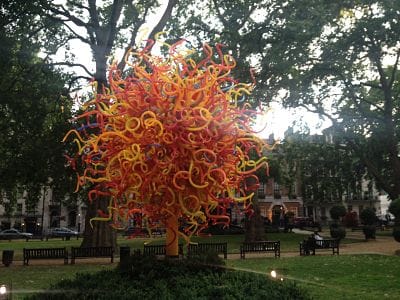
Bringing vibrancy and colour to the stuffy conservatism of Berkley Square, Dale Chihuly’s The Sun dawned back in April of this year. Five and a half metres high, it is composed of 1,573 hand-blown glass elements and is illuminated at night – to quite awesome effect. Taking over 2000 hours to create and five days to install, its popularity proves it was well worth all the effort.
I can’t help but be reminded of a gigantic sea anemone though, and half expect a massive clownfish to be bumbling about nearby. The Sun will shine until December this year, then disappear just as the winter gloom really kicks into high gear. Thanks for that, then.
Peace Descending On The Quadriga Of War
This magnificent depiction of the Angel of Peace landing upon the Chariot of War sits atop the Wellington Arch in Hyde Park Corner. Like a still from a Biblical epic, it was created by Adrian Jones way back in 1912 and remains London’s most arresting piece of art.
Every morning, the Household Cavalry ride through the arch beneath it on their way to the Changing Of The Guard, in an ongoing feat of epic irony that seems to be lost on all concerned.
Peace Descending On The Quadriga Of War replaced an equestrian statue of the Duke of Wellington that was so disproportionately huge compared to the arch it stood upon it was roundly mocked by the press. Jones’ work was the largest public sculpture in the UK until the unveiling of Anthony Gormley’s Angel Of The North.
It was an epic journey from conception to completion. In 1891 Jones exhibited a plaster Quadriga (four horses drawing a chariot) at the Royal Academy, where the Prince of Wales (later Edward VII) suggested he design one for the Wellington Arch. It took another twenty-one years for the final sculpture to be erected, long enough for the artist to find time to hold a tea party inside a cast for one of the horses!

Hahn/Cock
It’s a big blue cock in Trafalgar Square… says every other tour guide. Yes it is. But it’s so, so much more. It may seem obvious having a Fourth Plinth work on the list, let alone at number one, but Hahn/Cock by Katharina Fritsche fully deserves it’s place as the most prominent sculpture in the capital.
For a start, it’s so big… and so blue! It snaps your attention away from the dreary, monochrome grey of its surroundings. This iridescent fibreglass icon stands at almost five metres tall, and always has a congregation of pigeons worshiping at its feet. People flock around it too, in bafflement, wonder and also derision.
It has caused controversy – for many reasons, mostly for being completely out of place in Trafalgar Square. Not just physically, but historically, and not in keeping with the stern grandiosity of the area. But that is entirely the point. As Fritsche herself commented: “Humour is always a big thing for me. It stops things from becoming too severe.”
Trafalgar Square is filled with symbols of the state: statues of generals Havelock and Napier, as well as King George IV on his horse (before he expanded to a 56-inch waistline). Hahn/Cock (the double entendre was intended) playfully undercuts the strutting pomposity of these figures and, by extension, British imperial arrogance.
It is also hilarious to have a cockerel, the symbol of France, in such a Gallic colour, standing behind Nelson’s back as he gazes proudly towards the sea: A cheeky riposte to history. Katharina Fritsche claims it was not intended for her work to carry these connotations, but relishes the happy accident that it does: “it’s a nice humorous side-effect to have something French in a place that celebrates victory over Napoleon. He has come back as a cockerel!”
But there is even more to it. As the artist notes, these are all “male persons standing on pedestals”, and that Trafalgar Square is “…about male posing, about showing power, about showing … erections! I mean, look at that column!”
She expanded upon this theme in various interviews: “London is a business centre; there are streets round here like Jermyn Street specialising in men’s suits. There’s a real male culture around the place.”
Fritsch added: “It is a feminist sculpture, since it is I who am doing something active here – I, a woman, am depicting something male. Historically it has always been the other way around. Now we are changing the roles. And a lot of men are enjoying that.” Too right. I will be sad to see Hahn/Cock go at the end of this year. In the meantime, every glimpse of it is sheer joy.
This article was written by Jess Brownrigg, tour guide, writer and good friend of Fun London Tours!
Post Date: 15th December 2014
Author: Matt Gedge
One of the most common bits of trivia you may have heard a City of London guide mention is that although there are streets, alleys and lanes, you will never find a road in the Square Mile. No water-tight theory explains this, although it may be because the word ‘road’ only became popular from the 17th century, by which time the names of the streets in this ancient city had already been decided upon.
Unfortunately, for the purist, this wonderful anomaly is no longer technically true, as due to boundary changes in 1994, part of Goswell Road sits firmly in the Square Mile. Ah well…

However, venturing into the labyrinth of lanes and alleys in the City you will be struck by the stupendous array of evocative street names, testament to a fascinating past. Fish Street, Cloth Fair, Amen Corner, Ball Court – the list goes on – and despite the rather prudish decision to alter some names which may offend our modern sensibilities there are still enough beauties to make a ‘top 10’ list rather difficult and contentious!
But here are some of our favourite street names in the City of London, in a rather exciting countdown format. It is of course by no means a definitive list, so please add your own thoughts!
10. Knightrider Street
This road is but a remnant of a much longer street used by knights to ride to Smithfield for jousting tournaments in the 14th and 15th centuries. Near Smithfield is the similarly evocative Giltspur Street, formerly called Knyghtryders Strete. And yes, don’t worry Hoff fans, David Hasselhoff has his own little shrine in the adjacent Centrepage pub!
9. Friday Street
Thank God Its… Most probably named after a medieval fish market that was held here on Fridays. It is one of many streets in the Square Mile named after a product which was traded – for instance Milk Street, Wood Street, Poultry, Pudding Lane.

8. French Ordinary Court
This bizarre name for a gloomy passageway is supposedly derived from a 17th century French restaurant which served fixed price meals, known as ordinaries.
7. Love Lane
If you wanted to pay for sex in the middle ages, this was where you would come (conveniently just round the back of the Guildhall…) Talking of lurve, or more accurately, lust, check out the brilliantly named Cock Lane, supposedly renowned for its brothels in the 14th century.
6. Wardrobe Place
This really was the place where our fashionable monarchs kept their wardrobe in the late 1300s! A building stored the clothes used for state visits here.

5. Cripplegate Street
Named after one of the gates built by the Romans. It isn’t entirely clear where the word comes from, with three contenders. It could be derived from cripples who begged there, or from the legendary miraculous cure of cripples when Edmund the Martyr’s body was carried through in 1010, or possibly from the Anglo Saxon word Crepel, which means underground passage.
4. Mincing Lane
This isn’t the most camp street in the Square Mile, but the houses on this lane were once owned by the nuns of the church St Helen’s Bishopsgate. The medieval name for nun was mynchen, from which mincing derives.
3. St Mary Axe
This street takes its name from the now lost St Mary Axe church which once held an axe said to have been one of three used by Attila the Hun in slaying 11,000 handmaidens of an ancient English King. Of course!
2. Crutched Friars
Crutch or crouch is derived from the latin crux or cross, and on this street stood the Convent of the Crouched Friars, who were formed in 1298.
1. Hanging Sword Alley
This ominous passage just off Fleet Street was almost certainly named after a fencing and sword fighting school. It was also known as Blood Bowl Alley, located as it was in Alsatia – an area exempt from City laws after the Reformation, and known haunt of dangerous criminals.
Others which deserve an honourable mention:
Back Passage, Poultry, Prudent Passage, Pope’s Head Alley, Turnagain Lane, Staining Lane, Seething Lane, Magpie Alley, Little Britain, Cannon Street, Bull’s Head Passage, Savage Gardens, Old Jewry, Catherine Wheel Alley.

And these would have made the list if they hadn’t been changed by the prudish City of London Corporation. I mean, really, there’s nothing offensive about any of these is there?
Shiteburn lane (now Sherborne Lane), Pissing Alley (absorbed into Cannon Street), Stinking Lane (King Edward Street), not forgetting the ever popular Gropec*nt Lane…
Before you ask, alas such treasures like Bleeding Heart Yard and Frying Pan Alley are outside the Square Mile…
You can find out more about the unusual history of the City of London on our Square Mile, Ye Olde London and Liar Liar Tours. All of these walks are listed here.
Post Date: 27th December 2013
Author: Matt Gedge
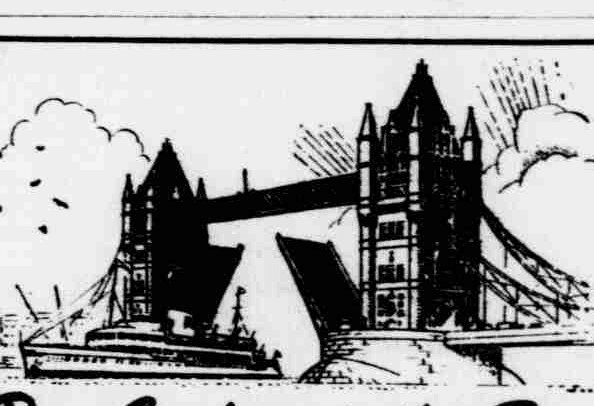
On 30th December 1952, an incident described as ‘1 in 150,000’ by the Daily Mail occurred when Tower Bridge began to open with a no.78 double decker bus on it. The bus in question was being driven from Shoreditch to Dulwich, and according to the driver Albert Gunter, it was travelling at about 12mph when suddenly the northern arm of the bridge began to lift.
Gunter realised that he had no option but to speed up otherwise the vehicle would have fallen into the River Thames. Luckily the south side was slower to lift which meant that the bus dropped the much more preferable several feet and miraculously remained upright.
The Daily Express of 31st December describes how within a few minutes of the incident the Bridge Master, Mr Leslie Priestly – who lived in a house on the south side – ‘put on his overcoat and bowler hat and was inspecting the bridge’.


Ambulances and fire engines were shortly in attendance, with the injured being carried from the bus on stretchers fashioned from seats which had been thrown from their frames in the drop.
Of the 20 passengers, 4 were treated for minor injuries on the bridge, and a further 10 were taken to Guy’s Hospital including the driver and the conductor. 11 year old Peter Dunn of Bermondsey suffered a fractured collarbone.
Although a ship had been scheduled to pass through the bridge, according to eye witnesses the traffic light had been green, signalling that it was safe for the bus to proceed. The superintendant engineer later admitted the men on duty in the north side control house had not noticed the bus and ‘a relief man was operating the bridge’.
Considering that Tower Bridge had been raised over 300,000 times before this incident, it is perhaps more amazing that this was the only time such an accident had occurred. Well, almost. In 1943 a van driver failed to see the warning light and crashed into a bascule.The aftermath of the Tower Bridge incident saw Albert Gunter becoming something of a minor celebrity. He received £10 from London Transport and £35 from the City of London for his speed of thought that saved so many lives. Four months later, according to the Daily Express of 8th April 1953, Gunter, 46 from Islington ‘can’t understand what the fuss is all about’, going on to say that at Dalston Garage ‘the boys still take it out of me. They call me Parachute Gunter and Waterwings!’

As his fame grew, the West London Observer reports how Albert Gunter was chosen to judge a driving competition at an event called ‘Better Roadmanship’ on the Serpentine Road in Hyde Park on July 25th 1953…
However for me the most heartwarming story is how after seven months of being incapable of travelling on public transport alone due to the incident, a Miss May Walshaw finally conquered her fears by taking the same route with the same driver across the same bridge. And two weeks later she was married with Albert Gunter as her best man!
Illustrations and newspaper cuttings are from London Observer, July 24th 1953 (illustration of Tower Bridge), The Courier & Advertiser, Wednesday December 31st 1952 (incident report), and the West London Observer, Friday July 24th 1953 (Road Safety Show)
Author: Matt Gedge
Post Date: 16th February 2013
Now that I’ve managed to find my way to the front of the queue in all the major attractions much easier thanks to the success of my first ‘Famous London Attractions and their Cheaper Alternative‘ post, I’ve decided to do another!
Westminster Abbey vs St Brides Church
Extraordinary history, staggering importance, wonderful architecture and modern romance, Westminster Abbey has it all. This is the site on which William the Conqueror was crowned on Christmas Day 1066, with the resulting jubilations inside sending his soldiers into panic on the outside, presuming unrest and setting fire to the surrounding buildings. It is where George IV’s coronation was memorable in that he banned his own wife, and where of course Kate and William were married in 2011.
You’ll have to face mega queues in the summer thought, and it’ll be exceptionally crowded inside, and of course pretty expensive for a church at £18 for adults.
However, if its romance and remembrance you’re after, you’ll struggle to beat St Bride’s Church. The spire is the inspiration for the wedding cake, inside there is an incredibly touching ongoing vigil inside to journalists lost or missing, while downstairs you will discover an incredible array of items – including an iron coffin used to deter body snatchers, part of a roman pavement and a medieval charnal house.
St Bride was said to be able to turn water into wine but if she’s not feeling so charitable today don’t worry as you’re on Fleet street where you’ll find some of the most atmospheric pubs in London!
London Aquarium v Wetland Centre
Sharks, piranhas, stingrays and jellyfish. (Un)fortunately you won’t find them splashing around in the Thames (although a whale did get lost in our famous river not so long ago).
But you will see them all if you head to the Aquarium on the Southbank. However, if the fear induced by your proximity to so many natural predators is mollified by the safety of all that thick glass, then at least one thing will get your heart thumping fast: the entrance fee. At £26.50 for an adult ticket you may decide to look around for alternatives rather than being stuck in a fishy amusement arcade locked inside an old government building.
So how about the Wetland Centre? This beautiful and serene oasis within the frantic pollutant that is London can provide a welcome break from all the hustle and bustle.
The focus here is on conservation, preservation and living in harmony with nature but there is a lot of fun for the kids too – most notably on the bat walks! Like the crew from a Star Trek episode beamed down to an alien world you’ll be given a bat detector which picks up the sounds unheard by the human ear and then walk around in the dusk waiting to see them fly by.
And you’ll get the entire family in here for only a few quid more than the adult ticket at the Aquarium.
London Eye v Secret London Walking Tour
The London Eye affords first time visitors to London a great opportunity to get a bird’s eye view of this wonderful city. As you move around at a sedentary pace you’ll be transfixed by the majesty of Parliament, the dominance of the River Thames and possibly by the screaming of a baby next to you.
But don’t worry, you’ll be released from your capsule a mere half an hour later, much like you were relieved of £119.80 for your family ticket a short while before…
Those of you who prefer to explore the delights of this city rather than merely observe through a window may wish to join the Secret London tour.
You’ll be entertained, informed, and regaled with stories about a side to London which is lost on the average tourist. This is the London you can touch, and feel, where you can peer through the cracks, betraying a rather unusual and curious living history. And you may even be able to touch the Duke of Wellington’s nose! All for £12 per person.
West End Theatre v Shakespeare’s Globe
I must admit I’m not a big fan of musicals, so this one is pretty easy. Rather than spend an uncomfortably large sum on tickets to something I would only consider if it were free, I would strongly suggest going to the Globe Theatre instead.
Standing under the summer skies watching actors fulfil a dream to perform Shakespeare in such a historical and beautiful setting is rather overwhelming. As is the contemplation of the love and thought put into creating not only the production but also the building itself, which replicated the building materials of 400 years earlier.
The atmosphere is electric, the sense of being in something together is quite moving, and when you pour out of the theatre a few hours later you’ll be looking out on the Thames rather than a bustling central London street. And at £5 per person, it has to be one of the most reasonable tickets in the whole of the city.
Chelsea FC v AFC Wimbledon
‘Blue is the colour, football is the game. We’re all together and Chelsea is our name. We’ll lead you through the sun and rain, cos Chelsea, Chelsea is our name!’. So sing the fans of Chelsea FC, one of the most successful football clubs of recent years, a glowing example of how London’s soul is being torn out by obscenely rich Russian oligarchs.
As you join in with the other 40,000 or so casual fans from around the world, watching mollycoddled superstars prance around under the doting eye of their sugar daddy Roman Abramovitch, you can reflect that once upon a time, this was a community club. Tickets to see ‘Chelski’ are astronomical, so why not watch REAL english football?
There are currently 12 other football league clubs in London, so you’re really spoilt for choice.
Brentford’s Griffin Park has the wonderful distinction of being the only football league club to have a pub at every corner of the stadium, but if you want romance and history, I’d suggest watching AFC Wimbledon. This is the club who came from non-league football all the way to the top and won the FA Cup against mighty Liverpool in 1988. They’re also the only club in modern times to be stolen from their fanbase and taken to Milton Keynes. (We don’t do franchising of sports teams in England).
So rather than relocate, the vast majority of fans took it upon themselves to start the club again and begin the journey once more. This is real fan investment, and you can really feel it when you watch a game.