Anyway, with Watkin and Forbes going every which way but round, by the 1880s the government was getting frustrated with the lack of a Circle Line, so a third, separate company was formed to fill in the gaps between the Metropolitan and District Railways. Watkin wasn’t happy with this at all, bought it out and decided to finish the job himself.
The first train to travel in a loop around London was in 1884. James Forbes and Edward Watkin rode in the same carriage as part of the celebration, but at opposite ends, and refused to say a word to each other the entire way round.


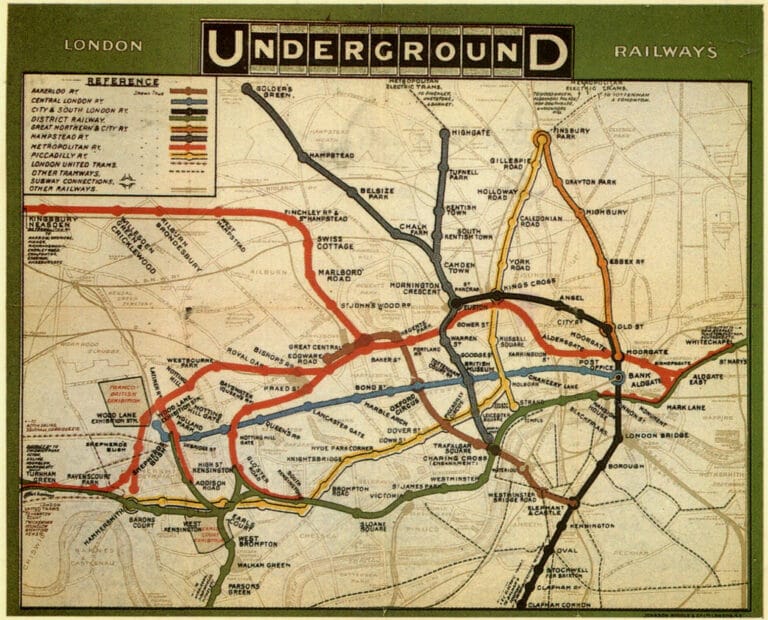
The enmity between these bitter rivals not only delayed the development of the underground, but also causes problem to this day. Watkin and Forbes set the tone for the rest of the network being built. Every one of London’s tube lines (apart from the Victoria and Jubilee Lines which came much later) were built by separate private companies competing with each other to bring passengers to popular parts of London, rather than cooperating.
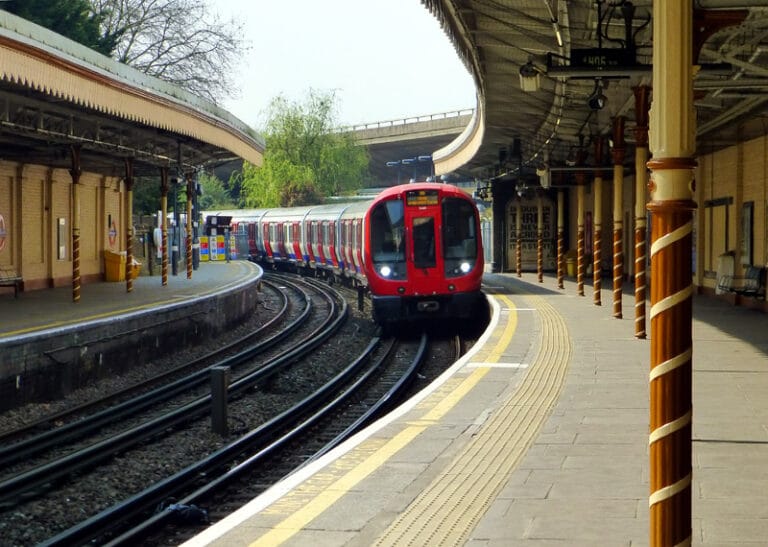
This is why there are two separate stations called Edgware Road that have nothing to do with one other. It’s why Hammersmith has two stations on opposite sides of the road. Why Euston has two different stations, as well as Aldgate.
Ever tried changing trains at Oxford Circus or Charing Cross and found yourself lost in a warren of endless, confusing tunnels? That’s because each was two separate stations combined into one. Finally it’s also why, when the entire network came together in 1933, many stations became redundant and were closed, leaving London with around 40 abandoned ‘ghost stations’ (see our other blog on Aldwich station, and the image of Down Street station below).

The London Underground is an iconic part of the city that, as much as its users grumble, they would never wish to do without. We owe its existence to the extraordinary vision of its creators, and its many annoyances to their equally massive egos.
Meanwhile, Edward Watkin was industriously creating new branch lines of his railway, going west and north. Since they used the same trains, his intention was to link his underground section in London to the other railways he owned in the North of England. Alas, this project ran out of funds, and ground to a halt 50 miles outside of the capital. Though not stretching out quite that far today, this is why the Metropolitan Line reaches further than any other London Underground line.
Another failed project of Watkin was to have tourist attractions along his route, to attract more passengers to his trains. As part of this scheme, he decided to build his own version of the Eiffel Tower, on a hill overlooking the capital, in Wembley.

It was to be bigger, taller, and better than the one in Paris, containing a 90 bedroom hotel, a theatre and restaurants. Eiffel was asked to design the landmark, but unsurprisingly declined to outdo his masterpiece in his own country. Undeterred, Watkin began construction in 1891.
When this project also ran out of money, he opened it to the public anyway in 1896, despite having only completed the first stage of the tower. Circus tents were erected on top, hoping to draw people up for some elevated entertainment. However, while the park around it proved popular, few people wanted to ascend the giant monstrosity, which soon came to be known as “Watkin’s Folly” and “The London Stump.”
The whole thing was dynamited in the early years of the 20th Century, and Wembley Stadium built there instead, opening in 1907

But Watkin had even bigger ambitions. He wasn’t only attempting to expand his railway north; he was also hoping to go south; further south than any British railway had gone before — to Paris. In the 1880s he submitted a plan for building a Channel Tunnel to Parliament. He even began tunneling in Kent.
The government, however, was having none of it. For one thing, politicians were worried that the technology of the time wasn’t up to the task, but their biggest concern was that France might invade from under the sea. No, that would not do at all.
That same fear was again raised when talk of the modern Channel Tunnel began in the 1970s. By then, it was the Soviet Union that was the concern. As was common during the Cold War, the solution was clear: if the Soviets invaded using the Channel Tunnel, there could only be one thing for it — nukes. The idea was to wait until a sizeable portion of the Red Army was in the tunnel, then blow it up. The only problem was this would convert the tunnel into a gigantic cannon, shooting nuclear material out at great velocity and destroying half of Kent.
Continue to Part 3
Love it or loathe it, the underground is a huge part of the London experience, for locals and visitors alike. People new to the city often find it overwhelming, while Londoners dread the daily commute in crowded carriages, shoved up against someone’s sweaty armpit.
Strong feelings about the Tube are nothing new. When the idea of an underground railway was proposed in the 1840s, the Times newspaper described it as “an insult to common sense”, and when it opened, the Prime Minister, Lord Palmerston, flatly refused to go anywhere near it. Meanwhile, a preacher in Smithfield foretold that it would bring about the End Times as we tunnelled into hell. Passengers during rush hour these days might not disagree.


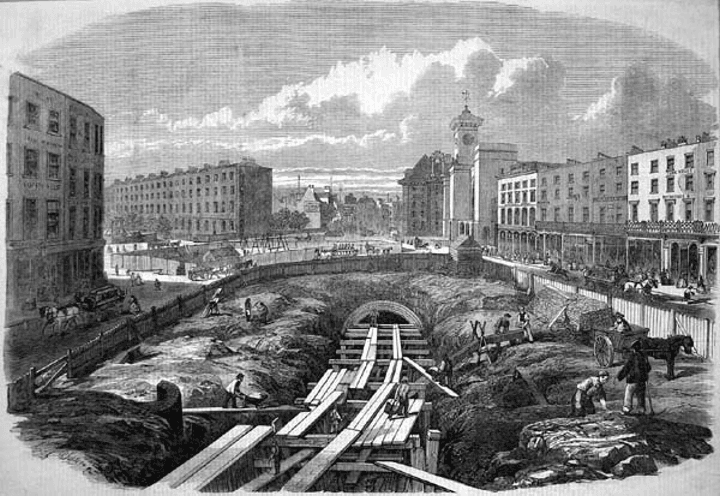
In the mid-nineteenth century, the narrow streets of London were a seething mess of open sewers, horse manure, and horrendous traffic jams of carriages and carts. Something had to be done to keep the city moving, so in 1854 a government commission decided that underground was the way to go.
The Metropolitan Railway was created by digging trenches along the city streets (causing even more traffic chaos, no doubt), laying track down, and covering it over again. They didn’t see the need to make new rolling-stock, so the line was built wide enough to accommodate steam-trains already in use above ground.
Unsurprisingly, the public were a little concerned about breathing in the smoke and soot particles in such a confined space, but the Metropolitan Railway assured them that it would be no worse than entering a steam room, and may even be beneficial if you have asthma…

The first stretch of underground railway anywhere in the world, running between Paddington and Farringdon, opened in January 1863, and was a huge success. On the very first day, 30,000 people travelled under the city streets. So, the government wanted more.
A separate company was founded to construct a railway through the south side of central London, along the river. Confusingly named The Metropolitan and District Railway, it had several board members from the Metropolitan Railway and the intention was that these two companies would cooperate to build a circular railway under London, and then merge. The initial stretch of the new line opened between South Kensington and Westminster in 1868.
However, as both companies ran into financial difficulties in the early 1870s, they were taken over by two railway magnates who hated each other’s guts. James Forbes became chairman of the Metropolitan and District Railway at the turn of the decade, while a couple of years later, his arch-nemesis, Edward Watkin took over the Metropolitan Railway.


Both were already bitter rivals in the rail transport business, and instead of cooperating to build a circle line, they literally took their railways in opposite directions to each other.
James Forbes expanded what we now call the District Line south-westward, connecting the towns of Ealing, Richmond and Wimbledon to Westminster by 1879. As much of the land was not heavily developed, it was significantly cheaper to build above ground out west than to go underground in central London. For one thing, they didn’t have to compensate for damaging wealthy city-dwellers’ property, or deal with the bad press of demolishing poorer people’s homes. The expansion was hugely popular, and facilitated London’s growth to encompass many once separate towns and villages. Continue to Part Two
Post Date: 1st December 2013
Author: Matt Gedge
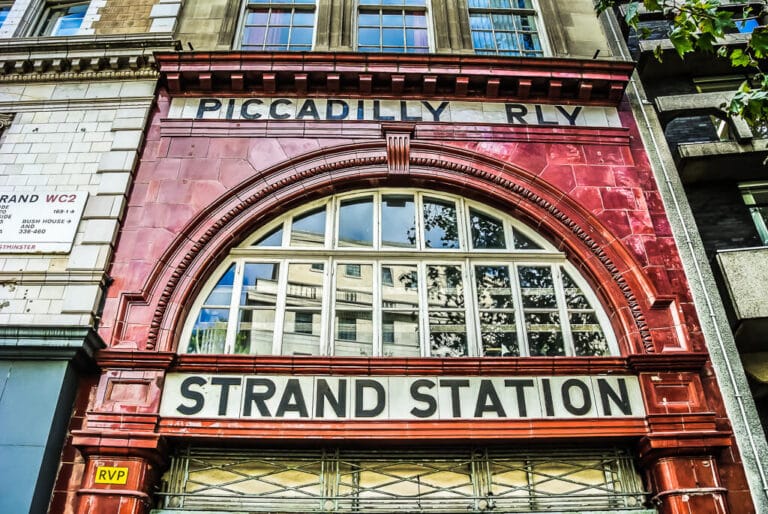
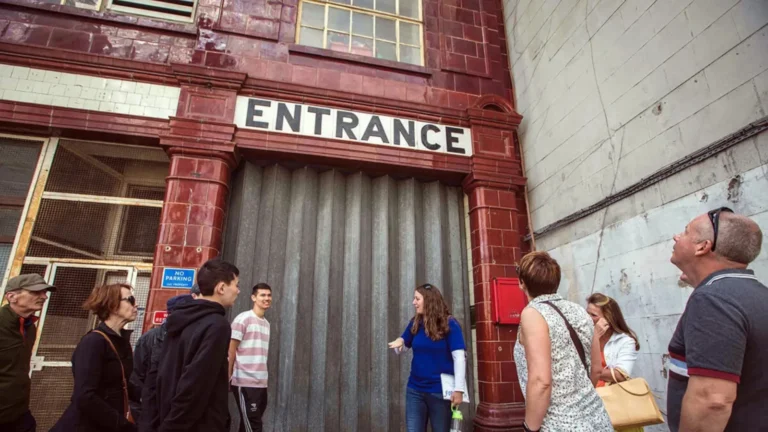
On 30th November 1907 the Strand Underground station opened. 87 years later it closed. Today we know it as Aldwych, and last week our London Tour Guide Matt was fortunate enough to join a few keen explorers of London’s past to descend the now disused stairs to the deserted tunnels and passages of a remarkable station.
From the sight of antique lift shafts to unfinished platforms, peeling posters from movies and original tiles displaying the name ‘Strand’, it was an exhilarating journey into this unique station’s ever evolving history.


The Strand was rather an anomaly from its inception. It was intended to be the southern terminus of one of the tube lines, but with the creation of the Piccadilly line from two separate projects, it was left looking like an extra leg tagged onto Holborn.
It then suffered an identity crisis when it was renamed Aldwych in 1915, with the station we now know as Charing Cross taking the name Strand (only to revert to ‘Charing Cross’ in 1979).
So it was a difficult start. Even during construction the decision was made to limit expenditure fearing that the station would be underused. As a consequence only one set of stairs and passages were built to the platform, which itself was only half completed.

The first few years of operation usually saw a two car train providing a shuttle service to only the western tunnel, and by 1914 the eastern tunnel wasn’t being used at all. Then during the German air raids in the First World War the disused platform was converted into a storage facility for 300 paintings from the National Gallery, and during the heaviest raids of 1917 it was used as a shelter for thousands of people.

Due to limited usage, within 15 years of its opening, Aldwych had closed its booking office. This led to small ticket booths being built into the lift cars, allowing the liftman to issue and collect tickets while taking people down to the platform.During the Blitz, Aldwych’s disused tunnel provided a home for thousands of valuable artworks and artefacts from the Victoria & Albert Museum and British Museum – including the Elgin Marbles – and one month after the station was closed, in October 1940 the station was sheltering up to 1500 people a night.


At first the conditions were awful, with a severe lack of toilet facilities and no water supply or drainage at platform level leading to great discomfort and a horrible stench. Within a month the situation had improved, with three tier bunks, chemical toilets and even a firm control on numbers through ticketing being implemented.It must have been an extraordinarily tough environment, as people spent the night in the tube then went to work the following morning. People were actually living in the underground, and for months numerous families would spend nearly all their free time in the company of each other, developing a renowned community spirit. A religious service was observed on Sundays and performers including the famous George Formby entertained the crowd.

Owing to the V1 and V2 raids in 1944-5, the platform continued to be a shelter even after the Blitz, while some of the museum artefacts were still being stored here in the mid to late 1950s.

Aldwych reopened in 1946, but by 1958 due to a lack of use, it scaled back its operation, only running services during rush hour. The disused eastern tunnel provided a location for full scale mock ups of future station designs from the 1960s, while TV and film crews took advantage of its long hours of closure to shoot scenes for movies like The Krays and Patriot Games.
Sadly, the number of passengers dwindled to around 450 a day, making its continued existence a constant drain on London Underground resources, costing £150,000 a year. So when the 87 year old lifts finally needed replacing in 1994, the cost of doing so couldn’t be justified, and so it closed.
And so today it stands as one of London’s disused underground stations, opening its doors every now and again for us to delve into a rather enigmatic piece of London’s underground history.
Movies featuring Aldwych include: Superman 4 (1986), V for Vendetta (2005), Atonement (2007), 28 Weeks Later (2007). And of course the music video Firestarter by the Prodigy!
With thanks to London Transport Museum.
Please note Fun London Tours does not organise tours of Aldwych station.
Author: Matt Gedge
Post Date: Sunday 13th January 2013
Its incredible to think the early underground trains were steam trains. To mark the 150th anniversary of the Metropolitan line, this train passed through Farringdon.
View the Video here.
https://www.youtube.com/watch?v=kyxpOT9l1Y4&feature=youtu.be