Visiting the Churchill War Rooms
Westminster was in the front line of the Blitz. Parliament was hit by bombs fourteen times, the House of Commons burned out in a single night in May 1941, and the same raid left Westminster Abbey open to the sky. A few hundred yards away, Churchill ran the war from the basement offices that are now the Churchill War Rooms. Much of what he knew still stands, and a short walk from the river to the War Rooms takes in most of it.
This guide follows that walk stop by stop, in the order our Churchill and the Blitz walking tour takes it: what happened at each place, and what you can still see today.
| Stop | Its wartime story |
|---|---|
| Battle of Britain Monument, Victoria Embankment | Names the 2,937 airmen who fought the Battle of Britain in 1940 |
| Palace of Westminster and Big Ben | Hit fourteen times; the Commons chamber was destroyed on the night of 10 to 11 May 1941 |
| Churchill’s statue, Parliament Square | Modelled on a photograph of him in the bombed Commons chamber |
| St Margaret’s Church | Where Churchill married Clementine in 1908 |
| Westminster Abbey | Its lantern tower collapsed in the raid of May 1941 |
| The Cenotaph, Whitehall | The dates of the Second World War were added in 1946 |
| Downing Street | Bombed on 14 October 1940, minutes after Churchill sent his staff to shelter |
| Women of World War II memorial, Whitehall | Seventeen sets of wartime clothing and uniforms, for the jobs women did |
| Horse Guards Parade and the Admiralty | Churchill returned to the Admiralty as First Lord in 1939; its concrete wartime citadel still stands |
| Churchill War Rooms | The underground headquarters where the war was run |
Because the two are one story. Through the summer of 1940 the RAF fought the Luftwaffe for control of the skies over southern England. On 7 September 1940, with the battle still being fought, the Luftwaffe turned to bombing London and other major British cities, and the Blitz began.
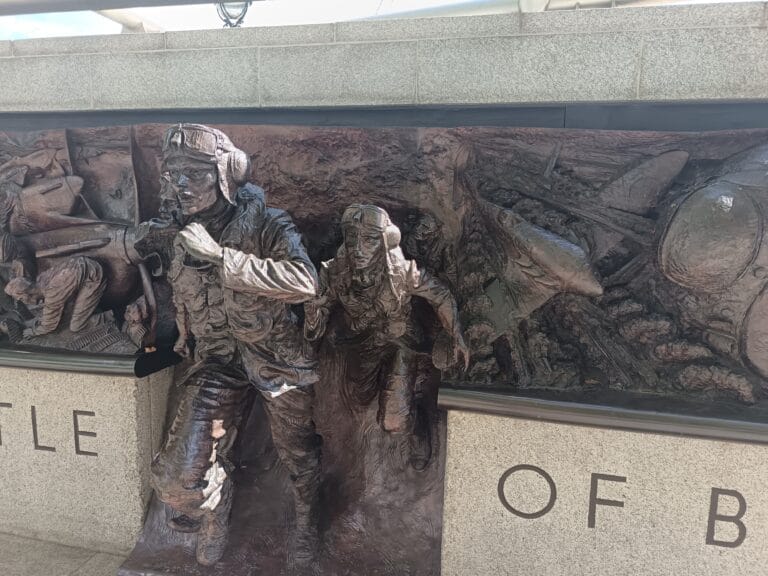
The monument stands on Victoria Embankment, overlooking the Thames, a few minutes’ walk from Westminster station. It was unveiled on 18 September 2005, the 65th anniversary of the battle, in the presence of surviving airmen. Its bronze reliefs, by the sculptor Paul Day, show scenes from the battle, and plaques along it list the 2,937 pilots and aircrew from fourteen countries who took part, the men Churchill called “the Few”.
The Palace of Westminster was hit by bombs on fourteen separate occasions. The worst came on the night of 10 to 11 May 1941, when the palace took at least twelve hits and three people were killed. Firefighters had to choose what to save, and they saved Westminster Hall, the oldest part of the building. The House of Commons chamber burned out completely.
For the rest of the war the Commons met in the House of Lords chamber. When the time came to rebuild, Churchill insisted the new chamber keep the old oblong shape, too small to seat every member, so that debates stayed close and crossing the floor still meant something. “We shape our buildings and afterwards our buildings shape us,” he told the House on 28 October 1943. The rebuilt chamber, designed by Sir Giles Gilbert Scott, opened in 1950. The archway into the chamber was left scarred by the fire on purpose, as a reminder of the war. It is known as the Churchill Arch.
Big Ben was damaged in the same raid. Its stonework and ironwork were damaged and the glass of the south clock face was shattered, but the clock kept accurate time and chimed throughout the Blitz. Its faces had been left unlit at night since 1 September 1939, so as not to guide bomber crews to Westminster.
The bronze statue, by Ivor Roberts-Jones, shows Churchill in a military greatcoat, leaning on a walking stick. The pose is based on a well-known photograph of him inspecting the ruins of the Commons chamber after the raid of May 1941. It stands about twelve feet tall on the north-east corner of the square, opposite the Palace of Westminster, and was unveiled by Clementine on 1 November 1973.
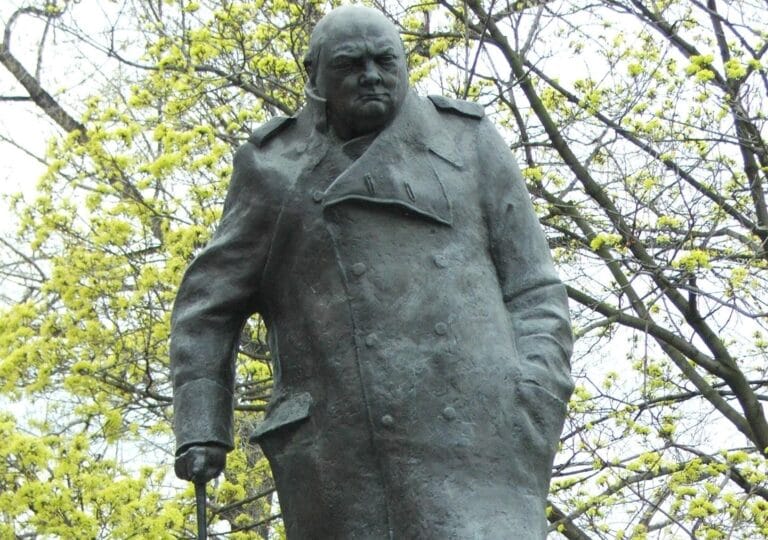
Churchill managed his public image in a way that was ahead of its time, but you’ll notice that this statue leaves out two of his trademarks, the cigar and the hat. Legend has it that Clementine worried the cigar would make a perfect perch for visiting pigeons, so it was left off.
At St Margaret’s Church, the smaller church between Westminster Abbey and the Houses of Parliament, on 12 September 1908. St Margaret’s has been the parish church of Parliament since 1614.
The church was damaged in the Blitz too. The Victorian glass in the south aisle was destroyed, and the abstract windows you see there today were designed by John Piper to replace it in 1966.
Yes, on the night of 10 to 11 May 1941, in the same raid that destroyed the Commons chamber. Incendiary bombs hit the roof and precincts, and the lantern tower above the crossing collapsed, leaving the abbey open to the sky. The deanery and three houses of the clergy and staff were badly damaged. The abbey had prepared: the Coronation Chair and many of its records had been moved out of London, and the Stone of Scone was buried. Services went on throughout the war.
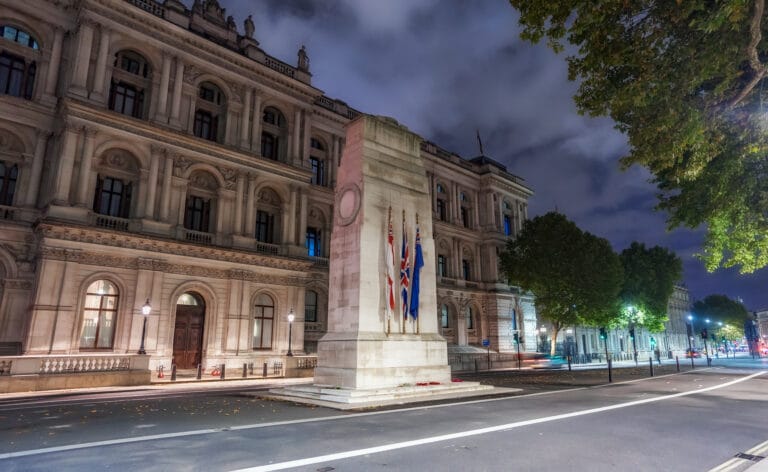
The Cenotaph was built for the First World War. Designed by Sir Edwin Lutyens, it was unveiled on Whitehall by King George V on 11 November 1920. After the Second World War it became the memorial to both wars: on 10 November 1946 King George VI unveiled the new dates carved on its sides, MCMXXXIX and MCMXLV, 1939 and 1945. It is still the centre of the national service on Remembrance Sunday.
On the evening of 14 October 1940, Churchill was at dinner at Number 10 when the raid began. He remembered the big window in the kitchen, got up, told the butler to put dinner on the hot plate and sent the cook and the other staff to the shelter. A few minutes later a bomb fell nearby and the kitchen, the pantry and the Treasury offices next door were wrecked. Three civil servants were killed.
After near misses like this, Churchill and Clementine moved into a flat above the War Rooms, known as the Number 10 Annexe, though he kept using Number 10 for meetings and meals. He made his VE Day broadcast from the Cabinet Room at Number 10 on 8 May 1945.
Downing Street is closed off by security gates, so today you see it through the gates from Whitehall rather than walking down it.
In the middle of Whitehall, a short walk from the Cenotaph, stands the national memorial to the women of the Second World War. It has no figures. Instead, seventeen sets of bronze clothing and uniforms hang around its sides, for the jobs women did in the war, from the Women’s Land Army to nursing, the police and factory work, as if left there by the women who wore them when the war was over.
The sculptor, John W. Mills, took the idea of women hanging up their uniforms and going back to their everyday lives. Queen Elizabeth II unveiled the memorial in July 2005, sixty years after the war ended.
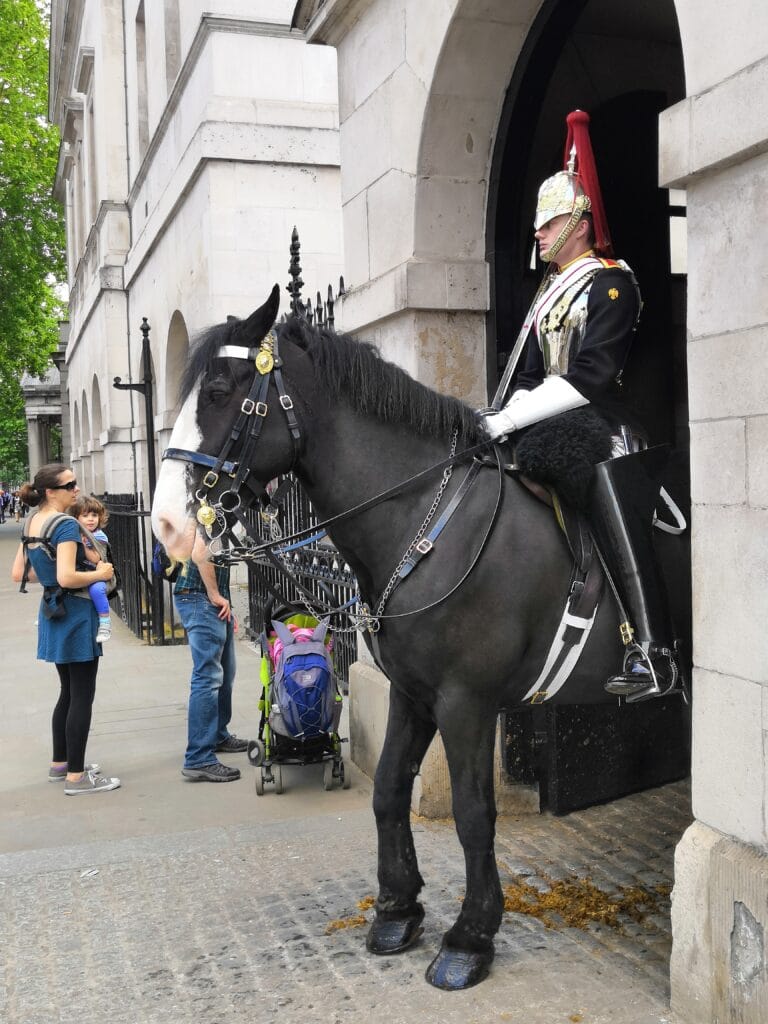
Further along Whitehall, the mounted sentries of the Household Cavalry stand guard at Horse Guards. Walk through its arches and you come out on Horse Guards Parade, with the buildings of the Admiralty along its north side.
Churchill was First Lord of the Admiralty, the minister in charge of the Royal Navy, at the start of both world wars. He returned to the post on 3 September 1939, the day Britain declared war on Germany, and held it until he became Prime Minister in May 1940.
Beside the Admiralty is the Admiralty Citadel, a windowless concrete bunker built as a bomb-proof operations centre, with a roof about 20 feet thick. Churchill called it a “vast monstrosity which weighs upon the Horse Guards Parade”. It is still used by the Ministry of Defence, and its walls are now covered in creeper.
Some of it, if you know where to look. On our walk, the guides point out shrapnel marks on government buildings along Whitehall, a lasting reminder of the bombing. The Piper windows in St Margaret’s replaced glass lost to the bombing, and inside Parliament the scarred Churchill Arch was kept on purpose, though you only see that on a tour of the Houses of Parliament.
At the foot of Clive Steps, at the St James’s Park end of King Charles Street. The step-free entrance is on Horse Guards Road. Our main guide to visiting the Churchill War Rooms has the walking route from Westminster and St James’s Park stations.
Our Churchill and the Blitz walk finishes at the entrance. Museum entry isn’t included on that walk, so if you want to go in afterwards, book your own ticket for a slot after the tour ends. If you’d rather not book separately, our small group tour with entry included covers the same streets and takes you into the War Rooms, and our tickets page explains the options.
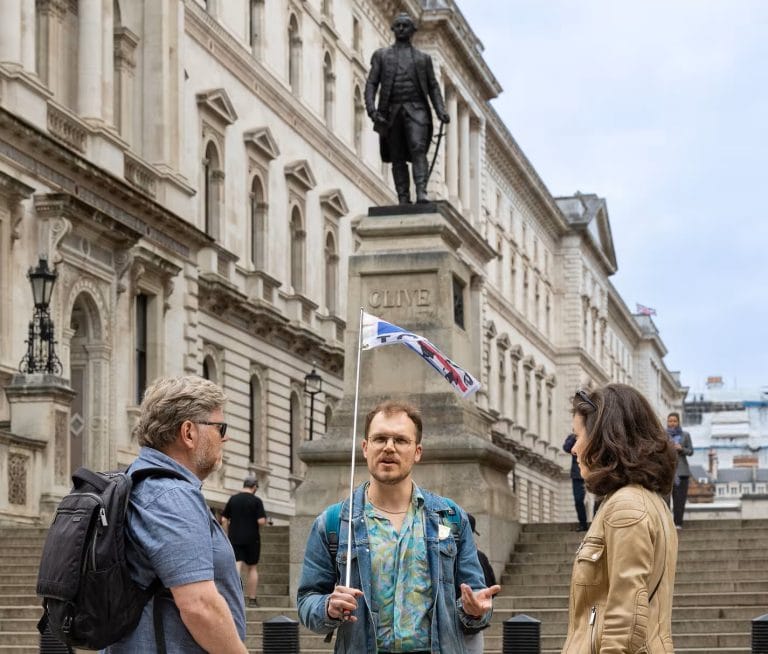
Yes. Every stop is on a public street or square, and the walk from the Battle of Britain Monument to the War Rooms is short, taking about an hour and a half with time at each stop. Going with a guide adds the stories behind each place, and what was happening there while the bombs fell.
Your guide will show you the streets and buildings of Whitehall through the story of Churchill and the Blitz, bringing the character and history of Westminster to life. They’ll also point out the details most people miss, and place each stop in the story of the Second World War.