Most people know Charles Dickens' A Christmas Carol as a ghost story. It's also a map.
Scrooge's counting house, Bob Cratchit's dash home to Camden Town, the poulterer's shop on Christmas morning: all of it sits in a real city. Dickens wrote it in 1843, and he said that while writing it he walked the black streets of London "fifteen and twenty miles many a night when all the sober folks had gone to bed".
Strip away the ghosts, and you find the City of London in winter. Clerks freezing at their desks. Families getting by on a wage that barely covers the rent. And a writer angry enough to do something about it.
Here's where that London came from, what's left of it, and where you can still walk it in 2026.
Why Charles Dickens Wrote A Christmas Carol, and How Quickly
Charles Dickens was 31 when he wrote A Christmas Carol. Born in Portsmouth on 7th February 1812, he finished the manuscript in late 1843 and saw it published on 19th December that year.
Young, famous and, crucially, worried.
His reasons came down to money, memory and anger. The book we read today grew out of all three.
A Writer Under Pressure in 1843
By 1843 the author of The Pickwick Papers was struggling. Martin Chuzzlewit, his new monthly serial, was selling well below expectations, and he had a wife, four children and a fifth on the way to support from his house on Devonshire Terrace in Marylebone.
Then there was the past he rarely spoke about. At 12 he was sent to paste labels on pots at Warren's Blacking warehouse, by the Thames at Hungerford Stairs near Charing Cross, while his father sat in the Marshalsea debtors' prison in Southwark.
February 1843 brought the second report of the Children's Employment Commission, which laid bare how children lived and worked in Britain's trades and factories. Dickens was appalled. He first planned a political pamphlet, then decided a story would land a far heavier blow.
Six Weeks to Publication
He started writing in October and finished in early December. Roughly six weeks, start to finish.
Unhappy with his publishers' terms, Dickens paid for the production himself: gilt edges, a gold-stamped cloth binding and hand-coloured illustrations by John Leech, all for five shillings. The first run of 6,000 copies had sold out by Christmas Eve.
Profits were thin because the book was so expensive to make. The boost to his reputation, though, was enormous. A Christmas Carol has never been out of print, and Dickens kept reading it aloud to packed audiences right up to his farewell performances in 1870, the year he died.
The City of London as Scrooge's World
Charles Dickens' A Christmas Carol never gives Scrooge a street address. It doesn't need to.
Every clue points to the City of London, the Square Mile of banks, merchants and insurers that was then, as now, the money engine of Britain. Map Scrooge's London and almost all of it fits inside a few hundred yards.
Scrooge and Marley's Counting House
A counting house was an office where a merchant kept his books, handled bills and lent or collected money. Scrooge's is small, dark and stingy with coal.
Bob Cratchit works in a "dismal little cell" beyond Scrooge's door, copying letters. Scrooge's fire is very small, but Bob's is so much smaller "that it looked like one coal", and he tries to warm himself at his candle.
Where is it, exactly? Dickens puts it on a narrow court near an old church tower whose "gruff old bell" peeps down at Scrooge, within easy reach of 'Change, the Royal Exchange. That suggests the tangle of lanes around Cornhill and Lombard Street, but anyone claiming the precise spot is guessing.
The Royal Exchange and the Business of Money
On 'Change, Dickens tells us, "Scrooge's name was good … for anything he chose to put his hand to." In plain terms, his credit was solid at the Royal Exchange, where merchants met to strike deals and trade bills.
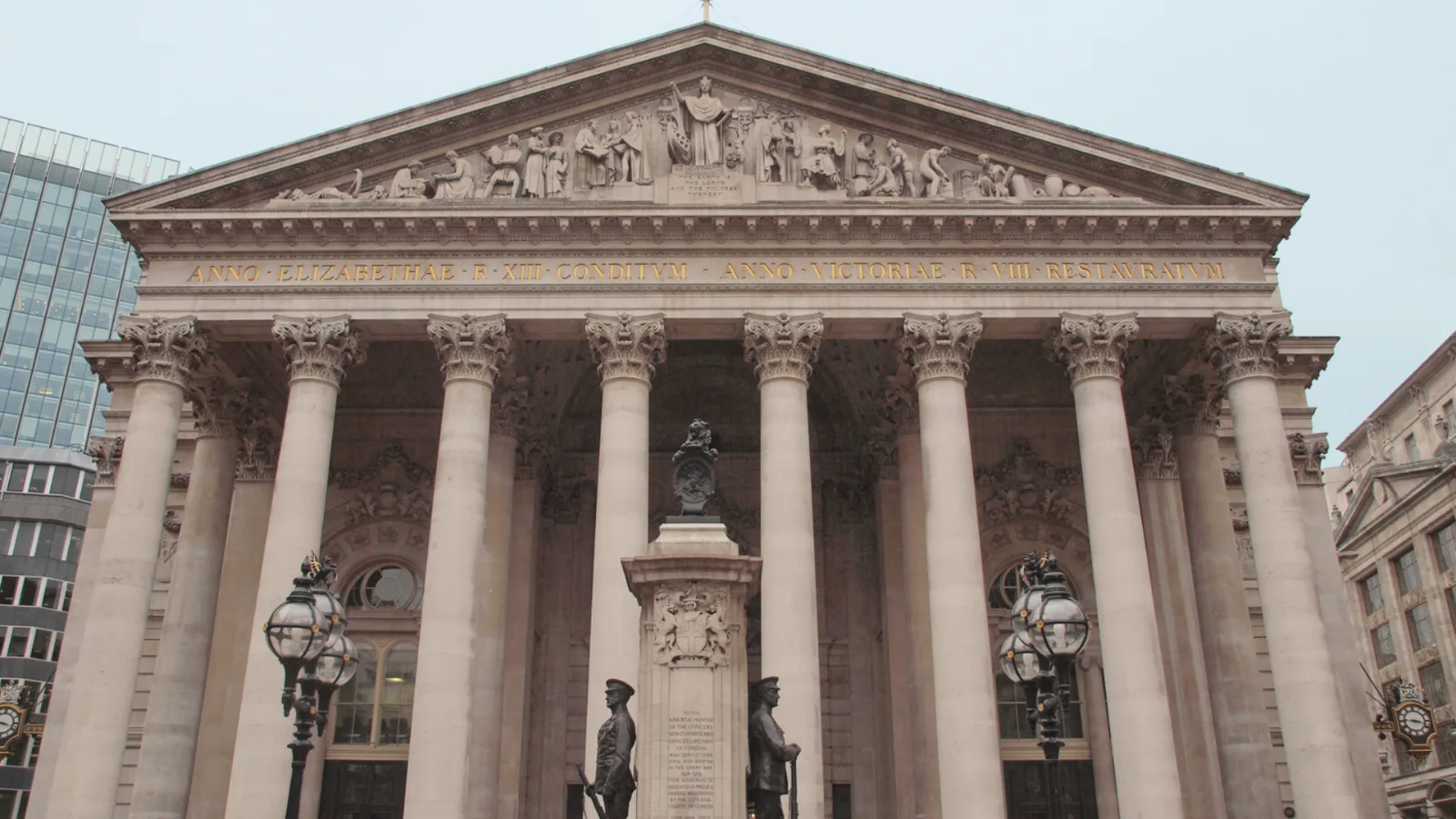
Now for an honest twist. While Dickens was writing, the Exchange was a building site: the previous one burned down in 1838, and Queen Victoria opened the columned building you see today in 1844.
Scaffolding or not, the streets around it hummed. Bankers lined Lombard Street, stockbrokers worked from the Stock Exchange in Capel Court, and merchants packed the chophouses and coffee houses of Cornhill.
Stave Four puts Scrooge among businessmen "upon 'Change" as they shrug off news of his own death. It's the coldest scene in the book, set in the busiest few acres of Victorian money.
Fog, Alleys and Gaslight
Open Stave One and you can almost taste the air. Fog pours in "at every chink and keyhole", the houses opposite are "mere phantoms", and candles flare in office windows when the City clocks have only just struck three.

This was a Victorian Christmas in London at street level: coal smoke, gas lamps and courts barely wider than a handcart.
Crowds everywhere, and Scrooge alone in the middle of them. That contrast is the whole point.
The Real Poverty Behind the Cratchits
Victorian poverty in the story isn't scenery. It's the argument.
Dickens knew London's poor from the inside: the debtors' prison, the warehouse floor, the cramped lodgings of his childhood. In 1843 he also visited the Field Lane Ragged School near Saffron Hill, a free school for the city's poorest children.
Workhouses, Child Labour and the Ghosts of Want and Ignorance
When two gentlemen ask Scrooge for a donation, he snaps back: "Are there no prisons? … And the Union workhouses?" Under the 1834 Poor Law, help for the destitute came mainly through the workhouse, made deliberately harsh so only the desperate would enter.
Later, the Ghost of Christmas Present reveals two children huddled beneath his robe: a boy, Ignorance, and a girl, Want. "Beware them both … but most of all beware this boy," the Ghost warns.
That warning comes straight from the Commission report and the ragged schools. Dickens believed children denied an education were being pushed toward crime and despair.
Camden Town and the Cratchit Home
On Christmas Eve, Bob runs “home to Camden Town as hard as he could pelt”. Dickens chose the spot with care: he had lived on Bayham Street there as a boy, when Camden was a cheap, half-finished fringe of London.
Bob earns fifteen shillings a week, or “fifteen copies of his Christian name” (a “bob” was slang for a shilling). It pays for a four-roomed house shared by Bob, his wife and their six children, but only because the older ones pitch in.
Martha, the eldest daughter, is apprenticed to a milliner, a maker of women’s hats and bonnets. She works such long hours that she arrives home late on Christmas Eve after finishing a rush of orders. Peter, the eldest son, is about to start work, and Bob has a job lined up for him that would bring in five shillings and sixpence a week. For Christmas dinner, Peter proudly wears one of his father’s shirt collars.
Then there’s Tiny Tim, the youngest. He is small and frail, walks with a crutch and has his legs supported by an iron frame. The Ghost of Christmas Present warns Scrooge that unless things change, Tim will not survive, and the family can’t afford the care that might save him. It’s Tim who gives the book its most famous line: “God bless Us, Every One!”
Their Christmas goose barely stretches round, padded out with apple sauce and mashed potatoes, and nobody dares call the pudding small. A few miles south, the City counted its fortunes, and Tiny Tim sits right in the middle of that gap.
Victorian Christmas Traditions the Book Helped Popularise
Read any list of Victorian Christmas traditions, and Charles Dickens' A Christmas Carol turns up near the top. Fair enough. Yet the book captured a revival already under way as much as it started one.
What Dickens Did and Did Not Invent
Christmas wasn't dying in 1843. It was changing. Carols were being collected and printed, and the first commercial Christmas card, commissioned by Henry Cole and designed by John Callcott Horsley, went on sale that same year.
Trees came a little later. The royal Christmas tree of Queen Victoria and Prince Albert became famous after the Illustrated London News printed an engraving of it in 1848.
"Merry Christmas" was centuries old too. What A Christmas Carol added was a moral centre for the season: generosity, family, warmth towards strangers and a duty to the poor.
He also handed the language a grumpy catchphrase. "Bah!" said Scrooge. "Humbug!" Bah humbug has been the motto of every Christmas cynic since.
Christmas on the London Streets
Stave Three reads like a walk through a Victorian Christmas in London. The poulterers' shops are "still half open", the fruiterers' are piled with chestnuts and "Spanish Onions", and the grocers spill over with raisins, almonds and cinnamon.
Londoners without ovens carried their dinners to the bakers' shops to be cooked, and Dickens shows exactly that on Christmas morning, with crowds bearing their dishes through the streets. Many families saved a few pennies a week for their bird through a goose club.
Once reformed, Scrooge leans out of his window and sends a boy to buy the prize turkey from the poulterer's "in the next street but one". Leadenhall Market was the City's own poultry market in his day, though its glass-roofed arcade dates from 1881.
Where to Feel Charles Dickens' London Today
Plenty of Dickens's City was lost to Victorian rebuilding, the Blitz and the office towers that followed. Plenty wasn't. Walk the courts off Cornhill on a dark December afternoon, and the scale still feels right: narrow, shadowed, close.
Surviving Streets, Courts and Pubs
These spots survive or keep their Victorian character.
-
Ye Olde Cheshire Cheese, Fleet Street. Rebuilt after the fire of 1666 and often linked with Dickens. It's also home to the legend of Fleet Street's foul-mouthed parrot.
-
The George and Vulture, Castle Court. An old chophouse hidden off Cornhill, where Mr Pickwick lodges in The Pickwick Papers.
-
Cloth Cornhill, Ball Court. Squeezed into a court near the Royal Exchange, this was Simpson’s Tavern, one of London’s oldest chophouses, serving since 1757 and counting Dickens among its diners. It closed suddenly in 2022 and has reopened as Cloth Cornhill, with its wood panelling, bow windows and high-backed booths restored.
-
St Michael's Alley and Change Alley. Narrow lanes off Cornhill that still follow their old lines. St Michael's Alley was home to London's first coffee house in the 1650s.
-
The George Inn, Southwark. London's last surviving galleried coaching inn, mentioned in Little Dorrit and now owned by the National Trust. A surviving wall of the Marshalsea stands nearby.
-
Charles Dickens Museum, 48 Doughty Street. His home from 1837 to 1839, where he wrote Oliver Twist. The Marylebone house where he wrote A Christmas Carol has long since been demolished.
Charles Dickens Christmas Carol: Where to Start
Start with the book itself. It's short enough to finish in an evening or two.
What Happens in the Story
Seven years after his death, Jacob Marley appears to his old partner, Ebenezer Scrooge, on Christmas Eve, dragging the chains he forged in life. Three spirits follow: the Ghost of Christmas Past, the Ghost of Christmas Present and the Ghost of Christmas Yet to Come.
By Christmas morning, Scrooge has changed.
Those five chapters are called "staves", an old word for the verses of a song. Dickens laid the whole book out like a carol.
Listen for a real one in Stave One. A boy sings "God bless you, merry gentleman! May nothing you dismay!" through Scrooge's keyhole, a line from God Rest Ye Merry, Gentlemen, and Scrooge chases him off with a ruler.
Themes Worth Noticing
For a quick analysis, start with redemption: nobody is too far gone to change. Then social responsibility, summed up by Marley's ghost crying, "Mankind was my business."
Time drives the plot, with past, present and future each getting a ghost. Family is Dickens's measure of a good life, from the noisy, loving Cratchits to Scrooge's nephew Fred, who keeps inviting his uncle to dinner, no matter how often he's refused.
Still Walking with Scrooge in 2026
Poets' Corner in Westminster Abbey holds Dickens's grave, far from Scrooge's cold little court. The world he built is still out there in the City: the alleys off Cornhill, the Exchange on its island of traffic, the old church bells on a dark afternoon.
One Last Stop
Read the book, then walk it. Fog optional.
If you would like to see the oldest streets of Dickens' City for yourself, join our Secret Old London tour, which finishes at Guildhall Yard just a short walk from the Royal Exchange.
Prefer Fleet Street, where Dickens worked as a journalist? Our Hidden London Tour explores the hidden alleyways off Fleet Street and the Strand.